The Ledger · Trades
How to Start a Lawn Care Business
Starting a lawn care business costs $7,688 to $21,349 in sourced 2026 figures, and on the free model's seeded numbers it takes 7.77 jobs a month to clear the nut.
Starting a lawn care business costs $7,688 to $21,349 in sourced 2026 figures — essential equipment, a used work vehicle, first-year general liability and a launch marketing budget. What decides whether it survives is not that number but the break-even one: how many cuts a month cover your fixed costs before you pay yourself a dollar.
Last updated: 2026-09-03
You are good at the work and bad at the business. That is not an insult, it is the most common sentence in every lawn care forum on the internet: the mowing is the easy part, and the pricing, the paperwork and the route are the parts nobody taught you. Search this question and you get equipment lists and encouragement. Almost nobody puts the arithmetic on the page. So this guide does the boring half — the cost stack, the floor price formula, and the break-even count — using the same sourced dataset behind our startup-cost comparison for 40 trades and the same formulas that run inside the free calculator.
How much does it cost to start a lawn care business?
Between $7,688 and $21,349, computed as essential equipment plus a used work vehicle plus first-year general liability insurance plus a launch marketing budget.
Those are not guesses at a national average, they are a sum. Each of the four components is priced from published retailer, insurer and industry sources, and added the same way for lawn care as for the other 39 trades on the comparison page. Lawn care is one of the cheaper trades to enter — it sits well below landscape installation, which needs a crew and a machine on a trailer.
| Component | Low | High |
|---|---|---|
| Essential equipment (mower, trimmer, edger, blower, trailer, safety gear) | $1,828 | $8,149 |
| Used vehicle + first-year general liability + launch marketing (total less equipment) | $5,860 | $13,200 |
| Total to start — Lawn Care | $7,688 | $21,349 |
| For contrast: Landscape Installation | $19,430 | $37,689 |
| For contrast: Tree Service | $13,414 | $36,536 |
The used vehicle is the largest single line for most trades, and it is the one line you may already own. If the truck is in your driveway and paid for, subtract it and the entry cost drops toward the equipment range on its own.
What is the lowest price you can charge and still make money?
Your floor price is your hard costs divided by one minus your floor margin minus any platform fee. Anything below that number loses money no matter how fast you cut.
This is the formula most pricing advice skips, and it is why "charge $45 because that is what the guy down the road charges" is not pricing. Here are the actual cell formulas the free Contractor Break-Even & Cash Model calculator runs, with the IFERROR guards stripped for readability:
HardCosts       = MatCost + SubLabor + JobMisc
JobContribution = AvgTicket - MatCost - SubLabor - JobMisc
FloorTicket     = HardCosts / (1 - FloorMargin - HouseFeePct)
TargetTicket    = HardCosts / (1 - TargetMargin - HouseFeePct)
FullNut         = fixed overhead + OwnerPay + LoanPayments
BreakEvenJobs   = (FullNut - RetainerContribution) / JobContribution
DaysBetweenJobs = 21 / BreakEvenJobs
MarginOfSafety  = (JobsPerMonth - BreakEvenJobs) / JobsPerMonth
Two things fall out of that immediately. First, the floor price is driven by the denominator, not by a markup: at a 30% floor margin and a 10% platform fee you are dividing by 0.60, which means your hard costs have to land at 60% of the ticket, not 70%. Second, a lead-gen app that takes 10% off the top does not cost you 10% of your profit — it raises the ticket you need in order to clear the same margin.
How many jobs a month do you need to break even?
Take your full monthly nut — fixed overhead plus your own pay plus any loan payments — subtract what recurring accounts contribute, then divide by the contribution one job leaves behind after hard costs.
The workbook ships seeded so you can watch the machine run before you type anything into it. The figures below are that shipped seed set, every one read back from the verified QA ledger for the Contractor Break-Even & Cash Model. They describe the seeded example and not you — a $900 average ticket is a repair or install call, not a mow. What carries over is the shape of the arithmetic, which does not change when you type your own numbers over the seeds.
| What the model computes | Seeded result | How it gets there |
|---|---|---|
| Fixed overhead, nine line items | $1,330 | sum of the nine fixed lines |
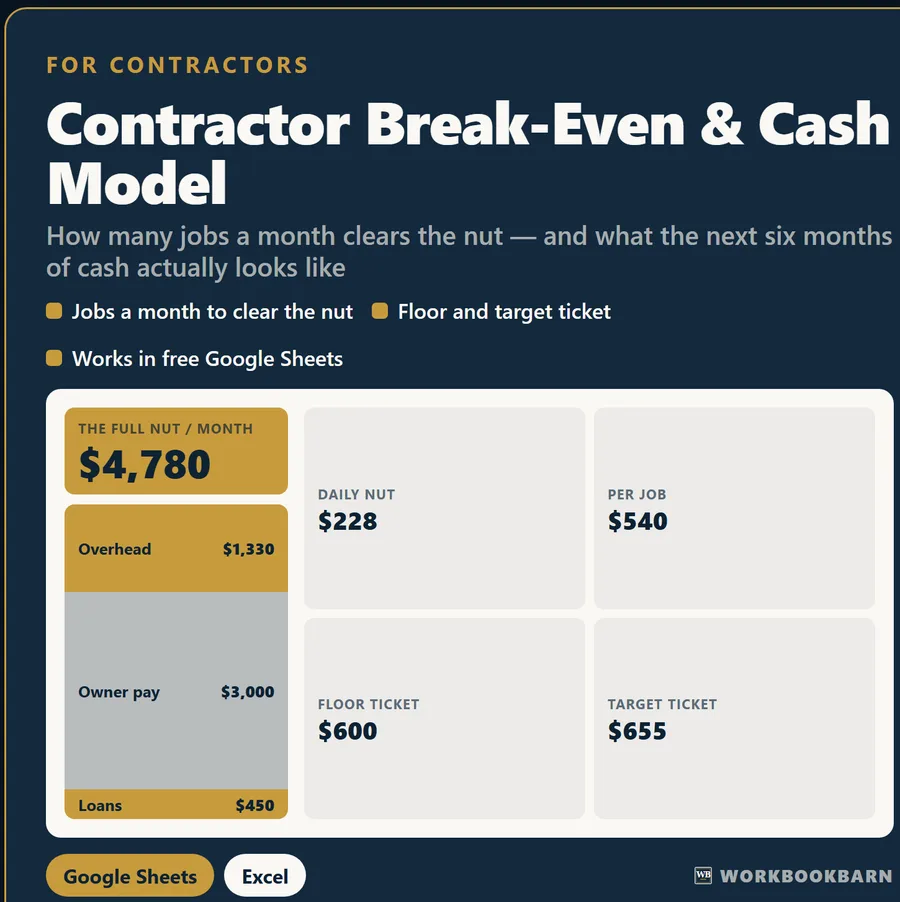
| The full nut (overhead + owner pay + loans) | $4,780 | cell F6 |
| Daily nut over 21 working days | $227.62 | 4,780 / 21 |
| Hard costs on the job | $360 | 150 + 180 + 30 |
| Platform fee held back | $90 | 10% of a $900 ticket |
| Contribution per job | $540 | 900 − 360 |
| Contribution rate | 60.0% | 540 / 900 |
| Net per job after the fee | $450 | 540 − 90 |
| Floor ticket at a 30% floor margin | $600 | 360 / 0.60 |
| Target ticket at a 35% target margin | $654.55 | 360 / 0.55 |
| Recurring-account contribution | $585 | accounts × fee × margin |
| Break-even jobs a month | 7.77 | (4,780 − 585) / 540 |
| Break-even revenue | $7,891.67 | cell F30 |
| Working days between jobs at break-even | 2.70 | 21 / 7.77 |
| Margin of safety at the seeded job count | 22.3% | cell F33 |
| Jobs to repay the seeded startup spend | 4.54 | cell F39 |
Now translate that to a mowing route, because three inputs move and the formula does not. AvgTicket collapses from hundreds to tens. JobsPerMonth climbs into the dozens. MatCost is close to zero on a straight cut, so almost the whole ticket becomes contribution — which is exactly why lawn care survives on volume, and why one lost route day is expensive in a way it is not for a trade doing eight big jobs a month.
The line most new operators overlook is the recurring one. In the model, RetainerContribution is subtracted from the nut before the division. For a lawn care company, your season-long mow agreements are that line: every account you sign lowers the number of one-off jobs you need to survive the month. That is the whole reason route trades chase contracts instead of calls, expressed as arithmetic instead of advice. Run your own numbers in the free calculator — nothing you type leaves your browser.
Do you need a license to spray fertilizer or weed killer?
For restricted use pesticides, yes, and that requirement is federal. Everything beyond that is set by your state, and it changes at the state line, so it is a question for your state agriculture department rather than a national guide.
The U.S. Environmental Protection Agency states that "Federal law requires any person who applies or supervises the use of restricted use pesticides (RUPs) to be certified in accordance with EPA regulations," and that certification programs are administered by all 50 states, the District of Columbia, four tribes, six territories and five federal agencies (page last updated 6 March 2026). That is the floor, not the ceiling. Many states also license commercial application of general-use products, and several require a business licence for the company on top of the applicator’s personal certificate.
Two consequences worth putting in the plan. The certificate belongs to a person, not to the company — so if your only certified applicator leaves, the spray revenue stops that day. And the exam fee, the study time and the renewal cycle are a genuine line item, which is why the workbook leaves licensing as a blank you fill in from your own state’s published schedule instead of printing a national number that would be wrong nearly everywhere.
Why does drive time decide your season?
Because the unpaid minutes between stops come out of the same day as the paid ones. Route density — lawns cut per mile driven — is the difference between a full schedule and a profitable one.
Two operators with identical price lists can land in very different places on the break-even table if one is cutting a tight subdivision and the other is crossing the county twice a day. That mileage has a published price attached to it: the Internal Revenue Service standard mileage rate for business use is 76 cents per mile for 1 July through 31 December 2026 (page last reviewed 28 July 2026). Multiply your own weekly business miles by that rate and the vehicle line in your overhead block becomes a defensible figure instead of a shrug.
The version of this that bites hardest is the one-more-account that sits fifteen minutes outside the route. It looks like revenue. In the model it is a ticket with an extra half hour of unbilled driving attached, and if your contribution per job is thin, that account is quietly a donation. Price the drive into the ticket or decline the stop — the arithmetic does not care which one you pick, only that you picked.
What happens in the off-season?
The nut keeps running when the grass stops growing. Insurance, any loan payment and your own pay do not take the winter off, so the cutting season has to fund the months that produce nothing.
This is why break-even is a monthly number while the plan is an annual one. On the seeded model, cash goes under before it recovers: the six-month tab puts the trough at −$2,728 in month two, with the first positive net month in month three. That is a seeded illustration and not a forecast, but the pattern is the one every seasonal route business lives through — you spend first, the cash lags, and the reserve is what carries you across the gap. The free Lawn Care companion kit ships a twelve-month forecast with this trade’s seasonality already shaped, the break-even hourly rate worksheet, and every printable page from the book.
What is actually in the plan?
Thirteen chapters and 54 printable worksheets, written as a fill-in business plan for a one-truck lawn care company rather than something to read once and shelve.
The Lawn Care Business Startup Plan & Workbook is a 142-page PDF at $14.99 on Etsy, and the companion kit above is free whether or not you ever buy it. There is no $997 course at the end of this page, no upsell ladder, no webinar. Every figure in the book cites a published source and every formula in the kit is machine-checked against the spreadsheet it came from — the same check that produced the verified numbers in the table above. If you would rather see the method run on a different trade first, the junk removal walkthrough uses the identical arithmetic on a much heavier cost stack.
Common questions
Can I start with just a push mower and the pickup I already own?
The sourced range starts at $7,688 with a used vehicle included, and essential equipment on its own starts at $1,828. If the truck is already yours and paid for, that equipment figure is the realistic entry number. What a smaller kit changes is not whether you can start but how many lawns a day you can physically finish, which is an input to the break-even count rather than an obstacle to it.
Do I need an LLC to cut grass?
Entity choice is a legal and tax question that varies by state, so it belongs with an attorney or a CPA and not with a startup guide. The workbook leaves licences, permits and entity filing fees as blank lines you fill in from your own state and county schedule, because a single national figure would be wrong nearly everywhere.
Is lawn care profitable?
That depends entirely on your ticket, your hard costs and your overhead, which is why the calculator computes it from your inputs instead of asserting an answer. On the model’s seeded figures it takes 7.77 jobs a month to clear a $4,780 nut. Change any input and the answer changes with it — no figure on this page is a projection of your results.
Contractor Break-Even & Cash Model
Run the numbers from this guide yourself — free, in the browser, no sign-up. Keep the full workbook if it earns its place.
Educational estimates only. These calculators and workbooks do the arithmetic on the figures you enter; they are general-purpose tools, not financial, investment, tax, legal, lending, insurance or construction advice, and no result is a quote, an offer, or a guarantee of any outcome. Results depend entirely on your inputs and assumptions. Verify anything you intend to rely on with a licensed professional — a CPA, attorney, lender, licensed contractor, or your own agent. WorkbookBarn and Marcos Gil accept no liability for decisions made using these tools. Marcos Gil is a licensed Kentucky real estate agent (License No. 296259) and is not a lender, CPA or attorney.