The Ledger · Operations
SOP Template: What Goes In One, and How Many You Can Keep Current
An SOP template needs eight sections, but the number that decides whether the library survives is the review load it signs you up for - and the workbook's seed register prices it at 124 reviews, 72.33 hours and $3,038 a year.
An SOP template needs eight things: a purpose, a scope, the owner’s name, the materials, the numbered steps, what gets recorded, the review date, and a revision line. The hard part is not the template. It is deciding how many procedures you can keep current, because every SOP you write signs you up for a review forever — and that bill is calculable before you write a single one.
What goes in an SOP template?
Eight sections: purpose, scope, owner, materials and equipment, numbered steps, records kept, review cadence, and revision history. Everything else is optional.
Every template on the first page of Google lists roughly these sections, and they all stop at the same place — the moment the document is written. Two of the eight are the ones that decide whether the procedure survives contact with a real crew: the owner and the review cadence. A procedure with no name on it belongs to nobody, and a procedure with no next-review date is a snapshot of how you worked on the day you wrote it.
| Section | The question it answers | Leave it out when |
|---|---|---|
| Purpose | Why does this procedure exist at all? | Never — it is the one line people read. |
| Scope | Which jobs, crews or sites does it cover? | You only have one crew and one service. |
| Owner | Whose name is on it when it is wrong? | Never. |
| Materials and equipment | What has to be on the truck before you start? | The procedure is office-only. |
| Numbered steps | What exactly do I do, in order? | Never. |
| Records | What gets photographed, signed or logged? | Nothing leaves the job as evidence. |
| Review cadence | When does someone check this is still true? | Never — this is the section that keeps the rest alive. |
| Revision history | What changed, when, and who changed it? | You are on version 1 and happy to lose the trail. |
What are the 5 components of an SOP?
The usual five are purpose, scope, responsibilities, the procedure itself, and references. That list is complete for writing one and incomplete for running twenty.
The five-component answer is what you will find in most quality-system training, and it is fine as far as it goes. It describes a document. What it does not describe is a register — the one-page list of every procedure you have, who owns it, when it was last reviewed and when it is due again. Five components make a document. A register plus a review date is what turns a folder of documents into something that is still accurate next spring.
How often does an SOP have to be reviewed?
For most small businesses there is no legal interval — you pick one. The one place federal law puts a number on it is worth borrowing as a benchmark.
Under the Process Safety Management standard, 29 CFR 1910.119(f)(3), the Occupational Safety and Health Administration requires that operating procedures “shall be reviewed as often as necessary to assure that they reflect current operating practice” and that “the employer shall certify annually that these operating procedures are current and accurate” (text current as of 2 October 2026). That standard applies to processes covered by PSM — highly hazardous chemicals — so it almost certainly does not cover your business. Borrow the cadence, not the obligation: annual is the floor the one federal rule with a number on it settled on, and monthly or quarterly is for the handful of procedures that change with the season, the price list or the crew.
How many SOPs can you actually keep current?
Count the reviews your cadences generate in a year, multiply by how long one review takes, and price that at a loaded hourly rate. That is your ceiling.
This is the arithmetic every template on the first page of Google leaves out, and it is the whole reason SOP libraries rot. Writing a procedure is a one-off cost. Keeping it true is a subscription you pay in somebody’s afternoons. Here is the chain the free calculator runs, exactly as the workbook runs it:
reviews_per_year     = (monthly SOPs x 12) + (quarterly x 4)
                       + (half-yearly x 2) + (annual x 1)

review_hours_per_year = reviews_per_year x minutes_per_review / 60

labour_cost_per_year  = review_hours_per_year x loaded_hourly_cost

hours_per_owner_month = (review_hours_per_year / 12) / number_of_owners
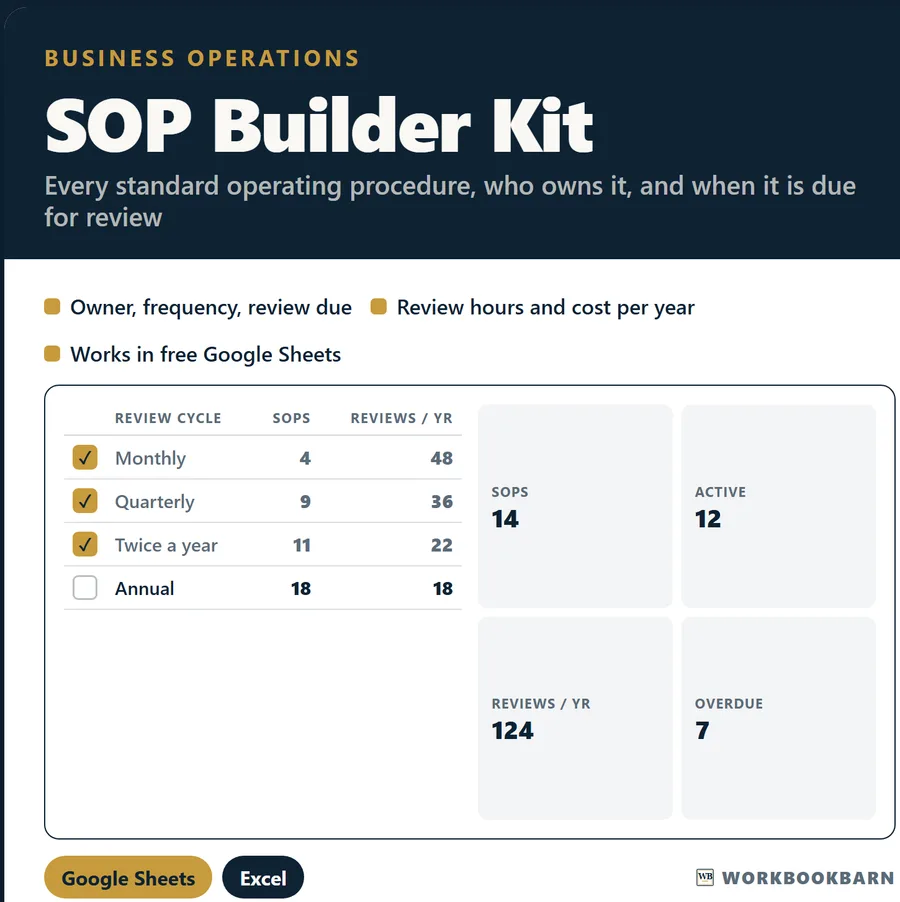
Run it on the seed register that ships inside the SOP Builder Kit — 14 procedures on the register, 12 of them active, spread across monthly, quarterly, half-yearly and annual cycles — and the workbook returns these verified figures:
| What the workbook returns | Figure |
|---|---|
| Reviews per year | 124 |
| Reviews per month | 10.33 |
| Reviews per week | 2.38 |
| Review hours per year | 72.33 |
| Review hours per month | 6.03 |
| Labour cost per year | 3,038 |
| Hours a month per SOP owner | 1.00 |
| People holding an SOP | 6 |
Two things fall straight out of those figures, and they are the numbers worth arguing about. Divide the hours by the reviews — 72.33 hours x 60 / 124 reviews — and the seed register assumes about 35 minutes to read a procedure, check it against reality, edit it and re-date it. Divide the cost by the hours — 3,038 / 72.33 — and it is pricing a reviewer at about $42 an hour loaded, which is wage plus payroll tax plus overhead, not take-home. Both are derived from the two verified figures above rather than quoted from the sheet, so change either input and the ceiling moves with it.
Fourteen procedures cost roughly six hours a month spread over six owners — one hour each, which is survivable. The shape of the curve is what matters: because a monthly cadence generates twelve reviews a year and an annual cadence generates one, putting ten procedures on a monthly cycle costs the same upkeep as putting a hundred and twenty on an annual one. The lever is almost never how many SOPs you write. It is which cadence you put them on.
That is also why the seed register is honest about its own state rather than showing a clean sheet: 3 overdue reviews, 3 due in the next 30 days, 1 never reviewed, and 50.0% of active SOPs current. A register that reads 100% is usually a register nobody has opened.
Is there an SOP template in Word?
Yes, and dozens are free — the document is the easy half. What Word cannot do is total up the review load across every procedure at once.
Use a document for the procedure and a sheet for the register. The procedure is prose: steps, photos, a signature line. The register is arithmetic: owner, cadence, last reviewed, next due, hours, cost. Trying to do the second job in a word processor is how businesses end up with 40 beautifully formatted procedures and no idea that 31 of them are out of date. The SOP Builder Kit is the register half, in Google Sheets and Excel, at $14.99.
How do I run this with my own numbers?
Put your own counts in the free SOP review calculator — how many procedures sit on each cadence, how long a review takes you, and your loaded hourly cost.
Time one review yourself before you guess at the minutes; it is the input the whole chain is most sensitive to. If the annual labour cost comes back bigger than the problem the procedures solve, the answer is not to abandon the library — it is to move the long tail onto an annual cycle and keep the monthly slots for the three or four procedures that actually change. If you want the same shape of arithmetic applied to jobs rather than procedures, the break-even guide works the same way.
Questions people ask
How long should an SOP be?
As long as the steps and no longer. If a procedure runs past two pages, it is usually two procedures wearing one title — and it will cost you two reviews a cycle either way, so you may as well split it and give each half an owner.
What is the difference between an SOP and a checklist?
An SOP explains how and why; a checklist is what you carry to the job. The SOP is reviewed on a cadence, the checklist is printed from it. Keeping them as separate artefacts means a wording fix does not force a reprint.
Do I need an SOP if I am the only person who does the work?
Write the three that would cost you most to get wrong while you are not there — the ones around money, safety and the handover to a customer. Put them on an annual cycle. One hour a year is a cheap price for the first day you are off the truck.
By Marcos Gil — licensed Kentucky REALTOR and Richmond roofing company owner. Educational only; every figure above is either quoted from the workbook’s tested seed register or derived from those figures in the open, and every external figure is linked and dated.
SOP Builder Kit
Run the numbers from this guide yourself — free, in the browser, no sign-up. Keep the full workbook if it earns its place.
Educational estimates only. These calculators and workbooks do the arithmetic on the figures you enter; they are general-purpose tools, not financial, investment, tax, legal, lending, insurance or construction advice, and no result is a quote, an offer, or a guarantee of any outcome. Results depend entirely on your inputs and assumptions. Verify anything you intend to rely on with a licensed professional — a CPA, attorney, lender, licensed contractor, or your own agent. WorkbookBarn and Marcos Gil accept no liability for decisions made using these tools. Marcos Gil is a licensed Kentucky real estate agent (License No. 296259) and is not a lender, CPA or attorney.