The Ledger · Money
Emergency Fund Calculator: How Many Months of Runway You Have
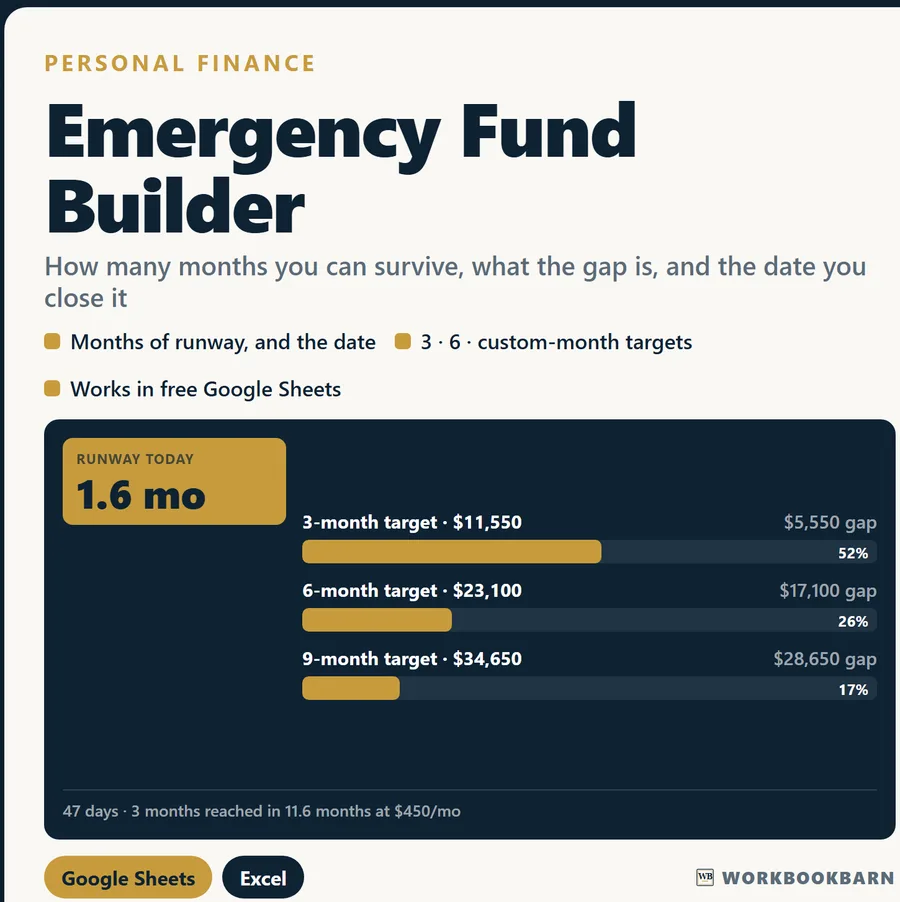
An emergency fund calculator divides the money you can reach today by one bare-bones month — on the tested seed figures, $6,000 against $3,850 is 1.56 months, or 47 days of runway.
An emergency fund calculator answers one question: how many months could you pay the bills if the income stopped today. You divide the money you can reach by one bare-bones month, and the answer is almost always smaller than people expect — on the seed numbers in our free calculator, $6,000 in savings against a $3,850 bare-bones month is 1.56 months, or 47 days. The number that matters next is not the target. It is the date you reach it.
Most pages ranking for this search are an embedded widget and a sentence. This one shows the formulas the widget is hiding, runs them on a tested set of numbers, and lets you run them yourself on the free emergency fund calculator.
How many months of expenses should an emergency fund cover?
Three months is the common floor, six months is the comfortable number, and nine to twelve is the range people with unstable income work toward. There is no single correct answer, which is why a calculator should show you all three at once rather than picking one for you.
The reason the months figure cannot be standardised is that it is not really about months. It is about how long it takes to replace the income. A salaried employee in a large field with a short hiring cycle is solving a different problem from a commission earner, a sole earner in a household, or a self-employed tradesperson whose slow season and a layoff look identical on a bank statement. The Consumer Financial Protection Bureau describes setting up a dedicated savings or emergency fund as one of the first steps you can take to start saving, and notes it works even when the amount you put aside is small.
You will also see the “3-6-9 rule” in search results. It is a memory aid, not a standard: three months if your income is stable and shared, six if it is one income or variable, nine or more if you are self-employed or in a field that lays off in cycles. Treat it as a starting point and then set your own target — in the calculator that is the “your own target, in months” field, which defaults to 9.
What is the emergency fund formula?
Four formulas do the whole job: one builds a bare-bones month, one totals the money you can reach, one divides them into months of runway, and one projects how long the gap takes to close at your deposit and your interest rate.
These are the actual formulas in the workbook and in the free calculator, named ranges and all — the calculator runs the spreadsheet’s own cells in your browser rather than a rewritten copy of them:
One bare-bones month   = Housing + Utilities + Groceries + Transport
                         + Insurance + DebtMin + OtherEssential
Money reachable today  = CurrentFund + OtherCash
MONTHS OF RUNWAY       = FundNow / MonthlyEssentials
Days of runway         = ROUND(RunwayMonths * 30.4, 0)

3-month target         = MonthlyEssentials * 3
Gap to 3 months        = MAX(0, Target3 - FundNow)
Percent to 3 months    = MIN(1, FundNow / Target3)
Months to 3 months     = NPER(SavingsAPY / 12, -MonthlyAdd, -FundNow, Target3)
Date you cross it      = EOMONTH(TODAY(), ROUND(NPER(...) + 0.4999, 0))

Custom target          = MonthlyEssentials * TargetMonths
Three details in there are the difference between a real projection and a guess. NPER is the periodic-payments function, so interest compounds monthly on a balance that is growing — a straight “gap divided by monthly deposit” ignores that. MAX(0, ...) on the gap stops the sheet showing a negative shortfall once you are past the target. And EOMONTH(... + 0.4999) rounds the finish to the end of the month you actually cross the line in, because no one funds half a deposit.
What does the math look like with real numbers?
On the seed figures the Emergency Fund Builder ships with — a $3,850 bare-bones month, $6,000 reachable, $450 a month going in at 4.1% APY — the fund is 51.9% of the way to three months and 26.0% of the way to six.
Every figure in this table is a verified cell from the workbook’s test ledger, not an illustration we typed in. The 31 figures in that sheet were rebuilt in code from the same inputs and compared cell by cell before release.
| Figure | Value |
|---|---|
| One bare-bones month | 3,850 |
| Money reachable today | 6,000 |
| MONTHS OF RUNWAY | 1.56 |
| Days of runway | 47 |
| 3-month target | 11,550 |
| Gap to 3 months | 5,550 |
| Percent to 3 months | 51.9% |
| Months to 3 at 450/mo, 4.1% APY | 11.58 |
| 6-month target | 23,100 |
| Gap to 6 months | 17,100 |
| Percent to 6 months | 26.0% |
| Months to 6 at 450/mo, 4.1% APY | 34.32 |
Read the two bottom rows together and the picture changes. The same household is 11.58 months from a three-month fund and 34.32 months from a six-month one. The second number is not twice the first; it is almost three times it, because the gap trebles while the deposit stays flat. That is why the three-month mark is where most plans start: the second half of the journey costs roughly twice what the first half did, at the same deposit.
How long will it take to close the gap?
Divide the gap by the number of deposits you are willing to make, then check that against the interest-aware projection. The split tells you whether your current rate is fast enough or whether the target needs to move.
- Close the 3-month gap inside a year:
GapTo3 / 12— $462.50 a month on the seed numbers. - The same thing weekly:
GapTo3 / 52— $106.73 a week, which is the version people actually keep. - Close the 6-month gap inside two years:
GapTo6 / 24— $712.50 a month. - What an extra $100 a month buys: the difference between two
NPERruns, × 30.4 — 60.73 days sooner to the three-month mark.
The APY field is where most projections quietly flatter themselves. The 4.1% in the seed set is a high-yield savings assumption, not a typical one: the FDIC put the national deposit rate for savings accounts at 0.37% in September 2026, with a national rate cap of 4.38%. If your fund is sitting in a checking account, set the APY to 0 and watch the finish date move — that is the honest version of the projection.
Is $10,000 or $20,000 too much for an emergency fund?
Neither figure means anything until it is divided by your bare-bones month. On the seed numbers here, $10,000 is 2.6 months of runway and $20,000 is 5.2 months — one is below the usual floor, the other is just under comfortable.
This is why a dollar question is the wrong question and runway is the right one. A household with a $1,500 bare-bones month is holding thirteen months in that same $20,000; a household with a $5,000 bare-bones month is holding four. Both numbers are produced by the same formula, FundNow / MonthlyEssentials, and both are available in seconds on the free calculator. The dollar amount is an output. Your runway is the measurement.
What counts as a bare-bones month?
What you would still have to pay if your income stopped tomorrow: housing, power, food, insurance, transport, minimum debt payments, childcare. Subscriptions, eating out, the gym and holidays are left out on purpose.
Those get cancelled in week one of a real emergency, so including them inflates the target you are saving toward. It is the most common way an emergency fund calculation gets abandoned: the number comes back enormous, the finish date lands years out, and the whole plan stops being believable. A floor built from the seven essentials keeps the target believable, and the comfortable version stays a separate calculation. If you are paid every two weeks rather than monthly, the same caution applies to the deposit side of the math — the biweekly budget guide covers why half your monthly bills is the wrong number to plan around.
Frequently asked questions
How accurate is the finish date?
It is a straight-line projection, not a prediction. It assumes the same deposit every month, expenses that stay flat, no withdrawals, and it rounds up to the end of the month you cross the line. Interest is included at the APY you enter, compounded monthly. Real life will move the date. Use it to decide whether your current rate is fast enough, then log what actually happens.
Three months or six months?
Three months is the floor almost everyone agrees on. Six is comfortable. If you are self-employed, work on commission, are the only earner in the house, or work somewhere that does layoffs, use the custom target and set it to nine or twelve. There is no single right answer, which is why the sheet shows you all three.
Does the workbook work in free Google Sheets?
Yes. File > Import > Upload > choose the file > Replace spreadsheet. Every formula was written to work in Google Sheets as well as Excel — no XLOOKUP, no LAMBDA, no add-ons, no subscription. It opens in Excel too; you get both in one purchase.
The free calculator answers the question once. The Emergency Fund Builder workbook keeps the answer current: a savings log that records what you actually put in and took back out, and a dashboard that tracks runway month over month — on the seed data, 0.51 months in month one and 1.25 by month twelve.
Emergency Fund Builder
Run the numbers from this guide yourself — free, in the browser, no sign-up. Keep the full workbook if it earns its place.
Educational estimates only. These calculators and workbooks do the arithmetic on the figures you enter; they are general-purpose tools, not financial, investment, tax, legal, lending, insurance or construction advice, and no result is a quote, an offer, or a guarantee of any outcome. Results depend entirely on your inputs and assumptions. Verify anything you intend to rely on with a licensed professional — a CPA, attorney, lender, licensed contractor, or your own agent. WorkbookBarn and Marcos Gil accept no liability for decisions made using these tools. Marcos Gil is a licensed Kentucky real estate agent (License No. 296259) and is not a lender, CPA or attorney.