The Ledger · Money
Biweekly Budget Template: Why Half Your Monthly Bills Is the Wrong Number
Hold back your annual bills divided by 26 from each paycheck, not your monthly bills divided by 2 — on $2,540 of monthly bills that is $1,172.31 instead of $1,270.
If you are paid every two weeks, hold back your annual bills divided by 26 from each paycheck — not your monthly bills divided by 2. On a $2,540 monthly bill load that is $1,172.31 a check instead of $1,270. The half-method is the single most common mistake in a biweekly budget template, and over a full year it quietly collects thirteen months of bill money to pay twelve months of bills.
Every number below is a real figure from the Budget by Paycheck workbook’s seed scenario — the same file whose 37 figures were rebuilt in code and compared cell by cell before release. You can run your own numbers in the free budget by paycheck calculator without buying anything.
How do you budget when you are paid every two weeks?
Take every bill you pay in a year, add them up, and divide that annual total by 26. That number comes out of every single paycheck, no exceptions.
That is the whole method. The reason it works is that your bills run on a calendar of twelve months and your pay runs on a calendar of fifty-two weeks, and those two calendars never line up. Fifty-two weeks divided by two is 26 paydays. Twelve months of bills divided across 26 paydays is not the same as half a month of bills taken twice — it only looks that way.
Hold back per paycheck = (monthly bills x 12) / 26

Seed scenario:
  ($2,540 x 12) / 26
= $30,480 / 26
= $1,172.31 per paycheck
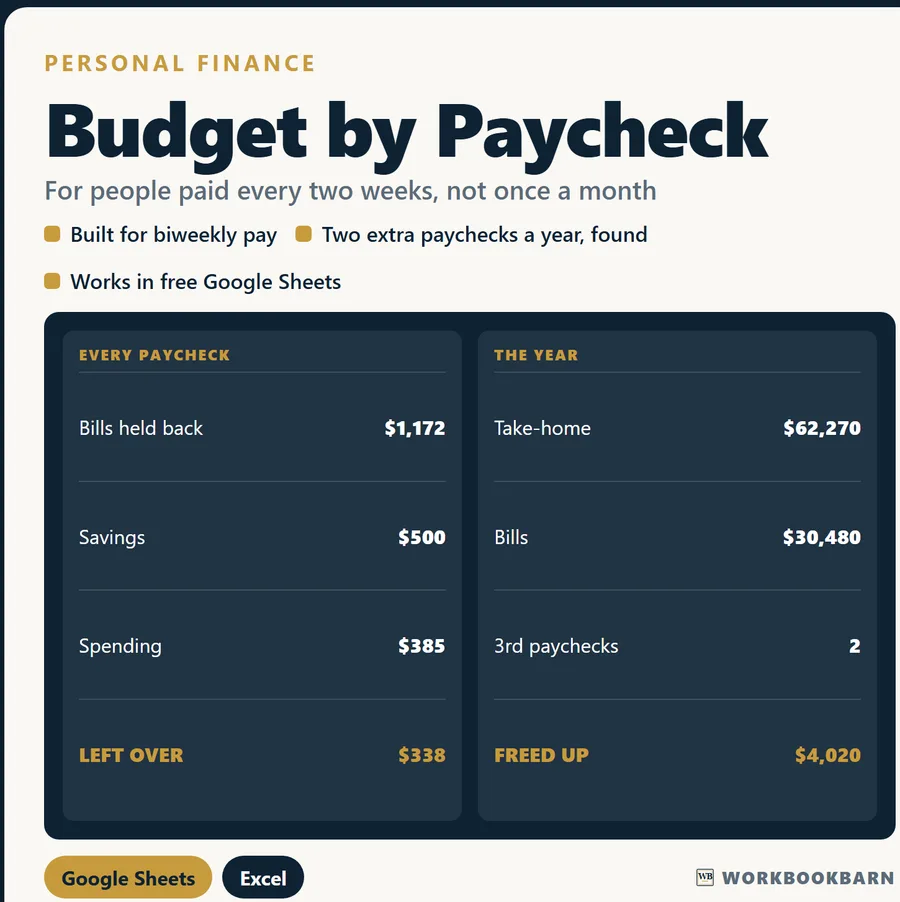
In the seed scenario that $1,172.31 sits alongside $500 of savings and $385 of spending money, which assigns $2,057.31 of each paycheck and leaves $337.69 unassigned. Over 26 paychecks that leftover is $8,780 a year that you never had to find — it was always there, it was just hiding inside a bill account that was collecting too much.
Why is half your monthly bills the wrong number?
Because half a monthly bill taken 26 times is thirteen months of bill money, not twelve. The shortcut over-collects by exactly one full month of bills every year.
It is an easy error to make and almost impossible to see, because nothing ever bounces. The bill account is always fat. You just never seem to have money for anything else, and the two extra paychecks a year arrive feeling like luck instead of like a line in a plan. Here is the same household run both ways:
| Figure | Half of monthly bills | Annual bills ÷ 26 |
|---|---|---|
| Held back per paycheck | $1,270.00 | $1,172.31 |
| Difference per paycheck | $97.69 | |
| Bill money collected over 26 paychecks | $33,020 | $30,480 |
| Bills the year actually has | $30,480 | $30,480 |
| Over-collected by year end | $2,540 | $0 |
The over-collection is $2,540 — which is not a coincidence, it is exactly one month of bills. The money is not lost. It is misallocated: $97.69 a paycheck was parked in a bill account by accident instead of sent to savings, a credit card, or a repair fund on purpose. That is the entire argument for doing the division properly.
Does this apply to you, or are you paid semi-monthly?
Biweekly means every fourteen days and gives you 26 paydays a year. Semi-monthly means twice a month on fixed dates — the 1st and the 15th — and gives you 24.
If you are paid semi-monthly, none of the arithmetic above is your problem: 24 paydays across 12 months is exactly two per month, half your monthly bills is the right number, and there is no third-paycheck month to plan for. Check your last three deposit dates before you go any further. If the gap is always fourteen days, you are biweekly. If the dates repeat every month, you are semi-monthly.
One wrinkle worth knowing: 26 is the normal year, not a law. Because a calendar year is 365 or 366 days rather than exactly 52 weeks, a biweekly payroll calendar occasionally lands 27 pay dates instead of 26. The U.S. Office of Personnel Management documents this directly in the fact sheet explaining the federal 2,087-hour divisor, which exists precisely because some years carry 27 pay dates (retrieved 30 September 2026). In a 27-payday year, divide by 27. Count your own paydays once a year and use the count you actually have.
Which months have three paychecks?
Two months a year catch three paydays and ten catch two, but which two is decided entirely by where your first payday of the year falls.
This is why a generic printable cannot tell you the answer and a calendar built from your own first pay date can. In the workbook’s seed scenario — first payday numbered 1 in early January — the PAY CALENDAR tab works out that January 2026 catches three paychecks and July 2026 catches three, while February and December catch two apiece. Move that first payday by a week and both three-paycheck months move with it. The calendar is arithmetic, not a lookup table, which is why it is the tab that actually earns its place.
What should the third paycheck actually do?
Assign it before it arrives. Once the $385 spending allowance is taken out of a $2,395 check, the seed scenario has $2,010 in play — $4,020 across both three-paycheck months.
The temptation is to treat those two checks as free money, and the reason the temptation is so strong is the over-collection problem above: when the bill account is quietly swallowing an extra month of bills all year, the third paycheck is the only moment anything ever feels loose. Fix the division and the third paycheck stops being a rescue and starts being the two biggest decisions of your year. The workbook’s PAYCHECK LOG tab shows what that looks like in practice — $500 left over on the third paycheck against $362 and $344 on ordinary ones, and $7,200 saved after twelve logged paychecks.
What do the percentages look like when it is working?
In the seed scenario bills take 48.9% of take-home, savings and extra debt payments take 20.9%, and day-to-day spending takes 16.1%, leaving the rest unassigned.
| Annual figure | Amount | Share of take-home |
|---|---|---|
| Take-home pay | $62,270 | 100% |
| Bills | $30,480 | 48.9% |
| Savings and extra debt | $13,000 | 20.9% |
| Spending | $10,010 | 16.1% |
| Left over | $8,780 | 14.1% |
These are one household’s numbers, not a rule and not a target. They are here so you can see what a finished biweekly plan looks like when the division is right, and so the ratios your own figures produce have something to sit next to. Run yours in the budget by paycheck calculator, and if you want the pay calendar, the paycheck log and the bill-account tracking as one file that opens in both Google Sheets and Excel, that is the Budget by Paycheck workbook. If you would rather start with the wider picture first, the guide on how to calculate net worth covers the other half of the same ledger.
Biweekly budget questions, answered
Will a biweekly budget template work in free Google Sheets?
Yes, if it was built for it. The Budget by Paycheck workbook uses an older, universal formula vocabulary — no XLOOKUP, no LAMBDA, no add-ons — so File > Import > Upload > Replace spreadsheet brings it into free Google Sheets intact, and the same file opens in Excel.
I get paid on the 1st and the 15th. Does the 26-paycheck math fit me?
No, and it is worth saying plainly. Twice a month is 24 paychecks and there is no third-paycheck month, so a pay calendar built on fourteen-day gaps will not match your dates. Half your monthly bills is the correct hold-back for you. Swap 26 for 24 anywhere you see it.
Where exactly do the two extra paychecks come from?
Fifty-two weeks divided by two is 26 paydays, and there are only 12 months. Ten months catch two paydays and two months catch three. Which two depends entirely on where your first payday of the year falls, which is why a calendar has to work it out from your date instead of guessing.
Budget by Paycheck
Run the numbers from this guide yourself — free, in the browser, no sign-up. Keep the full workbook if it earns its place.
Educational estimates only. These calculators and workbooks do the arithmetic on the figures you enter; they are general-purpose tools, not financial, investment, tax, legal, lending, insurance or construction advice, and no result is a quote, an offer, or a guarantee of any outcome. Results depend entirely on your inputs and assumptions. Verify anything you intend to rely on with a licensed professional — a CPA, attorney, lender, licensed contractor, or your own agent. WorkbookBarn and Marcos Gil accept no liability for decisions made using these tools. Marcos Gil is a licensed Kentucky real estate agent (License No. 296259) and is not a lender, CPA or attorney.