The Ledger · Money
How Long to Pay Off a Credit Card at the Minimum Payment
At a fixed payment the month count is -ln(1 - rB/P) / ln(1 + r); a credit card minimum is usually a percentage of the balance, which is what stretches the payoff.
At a fixed payment, the number of months is −ln(1 − rB/P) / ln(1 + r), where B is the balance, P the monthly payment and r the APR divided by 12. The catch is that a credit card minimum is usually not fixed — it is a percentage of the balance, so it falls as the balance falls, and that single detail is what turns a three-year payoff into a decade.
How long does it take to pay off a credit card at the minimum payment?
Long enough that federal rules force the card issuer to print the number on your statement every month, because the arithmetic surprises almost everyone who runs it.
There is no single answer, because the payoff length depends on three inputs and nothing else: the balance, the interest rate, and how the minimum payment is calculated. What makes credit cards different from a car loan is the third one. A car loan has a fixed payment, so the balance marches down on a schedule. A credit card minimum is typically set as a floor dollar amount or a small percentage of the balance, whichever is larger — which means the payment shrinks every month that the balance shrinks.
Rates matter too, and they are high right now. In its Federal Reserve G.19 Consumer Credit release of 7 October 2026, the average rate on credit card accounts assessed interest was 22.36% for August 2026, and 21.19% across all credit card accounts. At 22.36%, every $1,000 of balance accrues roughly $18.63 in interest in a single month before a dollar of principal moves.
What is the formula for months to pay off a credit card?
For a payment that stays the same every month, the closed-form answer is a logarithm — one line of arithmetic, no amortisation table required to get the month count.
r = APR / 12                      monthly periodic rate
N = -LN(1 - (r * B) / P) / LN(1 + r)

B = balance
P = the fixed monthly payment
N = months to payoff

In a spreadsheet:  =NPER(APR/12, -P, B)
The formula carries its own warning inside it. The term (r * B) / P is the share of your payment eaten by one month of interest. If that share reaches 1 — that is, if P ≤ r * B — the logarithm has no answer, because the balance never falls. At 22.36% APR the monthly rate is 1.863%, so a $6,000 balance accrues $111.80 in the first month; any payment at or below $111.80 leaves the balance flat or growing forever. This is the single most useful thing the formula tells you, and it is a yes-or-no question you can answer in one multiplication.
You can run both halves of this against your own balances in the free debt payoff calculator.
Why does a percentage-based minimum payment stretch the payoff so far?
Because the payment is tied to the balance, so both shrink together, and the last stretch of the balance is repaid at the slowest rate of the whole schedule.
Work it through. Suppose the minimum is 2% of the balance with a $35 floor. On a $6,000 balance the minimum is $120. After the balance has fallen to $3,000, the minimum is $60 — and interest at 1.863% monthly is $55.89 of that $60, so $4.11 of principal moves that month. The payment has halved, but the interest burden has only halved too, which means the ratio of principal to interest barely improves. The schedule does not accelerate as it goes; it decelerates, right up until the $35 floor finally takes over and starts behaving like a fixed payment.
The closed-form formula above does not apply to that case, and this is where most online calculators quietly differ from one another. A percentage minimum has to be iterated month by month, which is exactly what a spreadsheet row-per-month ledger does naturally and what a single-field web widget usually does not.
What does one extra dollar a month actually buy?
It buys a measurable amount of avoided interest, and the figure is specific to your own balances — which means it can be computed rather than guessed at.
The Debt Payoff Tracker ships with a seed file on its THE PLAN sheet so the formulas can be checked against known output before you put your own numbers in. That seed ledger carries four debts totalling $38,450, with minimum payments adding up to $745 a month. In the first month it shows $270.31 of interest. Left at the minimums, the ledger runs 64.34 months and accrues $9,481.71 in interest. Raising the monthly total to $945 — $200 more — changes the output as follows.
| Seed ledger (THE PLAN sheet) | At the minimums | With $200 extra |
|---|---|---|
| Total debt | $38,450 | $38,450 |
| Monthly payment | $745 | $945 |
| Months to debt-free | 64.34 | 48.09 |
| Total interest | $9,481.71 | $6,999.68 |
| Months sooner | — | 16.24 |
| Interest saved | — | $2,482.03 |
| Interest saved per extra dollar | — | $0.26 |
The bottom row is the one worth keeping. On that particular ledger, each extra dollar put against the debt avoids 26 cents of interest over the life of the payoff. That ratio is not a universal constant — it rises with the rate and with how early the extra payment starts — but it converts an abstract question into a number you can compare against anything else the dollar could do.
Where does the 36-month figure on your statement come from?
From Regulation Z, which requires card issuers to print a minimum payment warning and a three-year payoff estimate on each periodic statement.
Under 12 CFR 1026.7, published at eCFR, the statement must carry the bolded line “Minimum Payment Warning: If you make only the minimum payment each period, you will pay more in interest and it will take you longer to pay off your balance”, together with the estimated monthly payment that would repay the balance in 36 months, rounded to the nearest whole dollar. That printed 36-month payment is a free, issuer-computed data point sitting on a statement you already receive — and it is a useful cross-check on any calculator, including ours, because it is derived from your actual balance and rate.
Two related pieces of arithmetic on this site: how many months of expenses an emergency fund has to cover, and why a biweekly pay cycle produces 26 paychecks rather than 24.
Frequently asked questions
Does the formula work if my APR changes?
No. The closed form assumes one rate for the whole term. A variable-rate card has to be recomputed from the month the rate changes, using the then-current balance as the new B. A month-by-month ledger handles this by letting you change the rate on the row where it changed.
Why do two calculators give me different payoff dates for the same balance?
Almost always because they treat the minimum payment differently. One assumes your current minimum stays fixed for the whole term; another recalculates it as a percentage of the declining balance each month. The second is how most cards actually work and it produces a much longer answer. Check which assumption a calculator is making before comparing two of them.
Does the order I pay the cards in change the total interest?
Yes, when you have more than one balance. Directing the extra payment at the highest rate first minimises total interest arithmetically; directing it at the smallest balance first clears individual accounts sooner. The Debt Payoff Tracker computes both so the difference is a number rather than an argument.
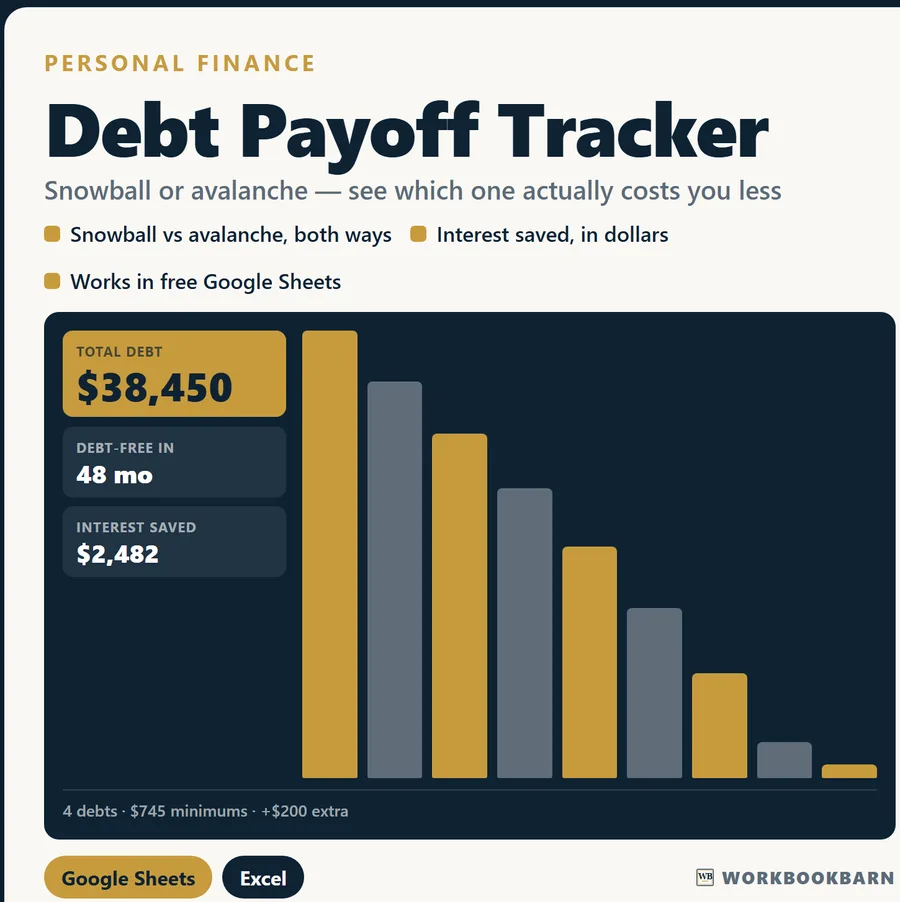
Debt Payoff Tracker
Run the numbers from this guide yourself — free, in the browser, no sign-up. Keep the full workbook if it earns its place.
Educational estimates only. These calculators and workbooks do the arithmetic on the figures you enter; they are general-purpose tools, not financial, investment, tax, legal, lending, insurance or construction advice, and no result is a quote, an offer, or a guarantee of any outcome. Results depend entirely on your inputs and assumptions. Verify anything you intend to rely on with a licensed professional — a CPA, attorney, lender, licensed contractor, or your own agent. WorkbookBarn and Marcos Gil accept no liability for decisions made using these tools. Marcos Gil is a licensed Kentucky real estate agent (License No. 296259) and is not a lender, CPA or attorney.