The Ledger · Trades
How to Start a Handyman Business: Costs, Rate and Break-Even
Starting a handyman business costs $12,680 to $37,393 in sourced 2026 figures, and the break-even hourly rate on the model's seeded numbers is $58.41 an hour.
Starting a handyman business costs $12,680 to $37,393 in sourced 2026 figures — essential equipment, a used work vehicle, first-year general liability and a launch marketing budget. The number that decides whether it lasts is a different one: the break-even hourly rate, which on the model’s seeded figures is $58.41 — below the bottom of every published handyman rate range you will read.
Last updated: 2026-09-07
You are good at the work and bad at the business. Every handyman forum has that sentence in it somewhere, usually followed by “how do I price jobs” and a truck seat full of receipts. Search this question and you get ten-step lists: pick your services, learn your state’s laws, buy tools, get insured. All true, all free everywhere, and none of it puts a number on the page. So this guide does the boring half — the cost stack, the break-even hourly rate formula, and the jobs-per-month count — from the same sourced dataset behind our startup-cost comparison for 40 trades and the same arithmetic that runs inside the free calculator.
How much does it cost to start a handyman business?
Between $12,680 and $37,393, computed as essential equipment plus a used work vehicle plus first-year general liability insurance plus a launch marketing budget.
That is a sum, not a guess at a national average, and the four components are added the same way for handyman work as for the other 39 trades on the comparison page. Handyman is one of the cheapest trades to enter on the equipment line and one of the most expensive on the lines nobody budgets for. The high column below is what the free companion kit seeds into its Startup Budget tab — deliberately the high end of every published range, so your own quotes typed over it can only move the total down.
| Component | Seeded figure (published high end) |
|---|---|
| Essential equipment, day one (12 items: drill $120, toolbox $150, tool belt $60, ladder $45, and eight more) | $660 |
| Used cargo van (2019 Ford Transit Connect, roughly seven years old) | $20,992 |
| General liability insurance, year one | $4,641 |
| Launch marketing | $11,100 |
| Total to start — Handyman, high | $37,393 |
| Same four components, low end (comparison page) | $12,680 |
| Reserve the kit adds on top (10%) | $3,739.30 |
| Cash needed to start, on the seeded figures | $41,132.30 |
Read the equipment line twice. Twelve tools, $660 at full retail, and the published range starts at $195 if you already own half of them. Almost nothing that makes this business expensive is a tool. It is the van, the insurance and the money it takes to get a phone to ring — $36,733 of a $37,393 stack. That is the part the ten-step articles skip, and it is why so many handymen “start” on a Saturday and quietly stop three months later: the tools were never the barrier.
What hourly rate do you have to charge just to break even?
On the kit’s seeded figures, $58.41 an hour. That is the rate at which an hour pays for your wage, your payroll burden and your share of fixed overhead, and returns you exactly zero profit.
Here is the formula the Pricing tab actually runs, cell for cell — not a rule of thumb, the live expression:
billable hours per month = billable hours per week × 4.33

break-even hourly rate  = ( wage × (1 + burden%) × hours/month + overhead )
                          ÷ hours/month

rate at target margin   = break-even hourly rate ÷ (1 − target margin)

jobs per month to clear = ( wage × (1 + burden%) × hours/month + overhead )
                          ÷ ( average ticket × target margin )
And here is that formula run on the figures the kit ships with, so you can check every step against your own calculator:
| Step | Arithmetic | Result |
|---|---|---|
| Billable hours per month | 30 hrs/week × 4.33 | 129.9 |
| Wage plus burden, per hour | $37.11 × 1.25 | $46.39 |
| Labour cost for the month | $46.39 × 129.9 | $6,025.74 |
| Plus fixed overhead | $6,025.74 + $1,562 | $7,587.74 — the monthly nut |
| Break-even hourly rate | $7,587.74 ÷ 129.9 | $58.41 |
| Rate at a 35% target margin | $58.41 ÷ 0.65 | $89.86 |
| Jobs a month to clear the nut | $7,587.74 ÷ ($948 × 0.35) | 22.87 |
Run your own numbers in the free contractor break-even calculator — it is the same engine, in your browser, nothing to download. Change the overhead line first; it is the one most people guess at and the one that moves the answer most.
Why does the published $60–$125 rate range mislead you?
Because published ranges are quoted against hours you bill, while your costs run against every hour you work. On the seeded figures the bottom of the published range sits barely above break-even.
Look at what the arithmetic just said: $58.41 to stand still. The commonly published handyman range starts around $60. If you charge the low end of what the internet tells you the market pays, you are working a full month for the difference between $58.41 and $60 — on the hours you actually billed, before you have paid yourself a cent of profit.
Then subtract the hours nobody pays for. The model assumes 30 billable hours a week, which is not a 30-hour week — it is a full week minus quoting, driving, chasing parts, invoicing and the customer who wants to walk you around the house first. Drop to 20 genuinely billable hours and the same overhead spreads over 86.7 hours instead of 129.9, so the rate has to climb. We ran that spread separately: our handyman hourly rate to take home $50,000 page computes $58–$61 an hour at 20 billable hours a week against $39–$41 at 30, using the same engine.
How many jobs a month do you need?
22.87 on the seeded figures — a $7,587.74 nut divided by the $331.80 of margin a $948 job throws off at 35%. Call it 23 jobs, and note that the kit’s own expectation line says 12.
That gap is the whole point of running the number before you start rather than after. The Pricing tab ships with “jobs per month you expect” seeded at 12 and computes that you need 22.87 to clear the nut at that ticket and that margin. Nothing is wrong with the spreadsheet; it is showing you that on those inputs the plan does not close. You have four levers and only four: raise the ticket, raise the margin, cut the overhead, or do more jobs. A guide that hands you an encouragement paragraph instead of that division is not helping you.
Seeing the same arithmetic on a different cost stack is worth ten minutes before you commit — the lawn care walkthrough runs the identical formulas on a trade with cheaper equipment and a thinner ticket.
What do you set aside for self-employment tax?
Plan around the statutory self-employment tax rate of 15.3%, which the Internal Revenue Service states is 12.4% for Social Security plus 2.9% for Medicare (retrieved 2026-09-07).
None of the rates above include it. The break-even hourly rate covers wage, burden and overhead; self-employment and income tax come out of what is left. Federal and state income tax vary far too much by situation for anyone to put a single honest number on a page, which is why the workbook leaves them as lines you fill in with a CPA rather than a figure we invent for you. This is a planning tool, not tax advice.
Do you need a licence to work as a handyman?
It depends on your state and county, and often on a dollar threshold per job above which the work requires a contractor’s licence rather than none at all.
That is a genuinely unsatisfying answer and it is the only honest one, because the rules differ by state, by trade within a state, and by the size of the job. The workbook keeps a state table for this in its licensing chapter, and the Startup Budget leaves licences and permits as a blank line seeded at $0 — not because it is free, but because a single national figure would be wrong nearly everywhere. Get your number from your own state licensing board before you quote a job that might cross a threshold, and treat electrical, plumbing and gas work as licensed trades until your board tells you otherwise.
What is actually in the plan?
The free handyman companion kit is the Excel financial model this whole guide was computed from: a Startup Budget tab seeded with the published high end of every range, a Pricing tab carrying the break-even formulas above with the arithmetic live, a twelve-month forecast with this trade’s seasonality, and every worksheet from the book as a printable PDF. It costs nothing and it does not need the book to work.
The Handyman Business Startup Plan & Workbook is a 142-page PDF at $14.99 on Etsy — the 13-chapter plan you fill in, covering licensing, flat-rate pricing, offers and leads. There is no $997 course at the end of this page, no webinar, no upsell ladder. Every figure in the book cites a published source and every formula in the kit is machine-checked against the spreadsheet it came from, which is the check that produced the verified numbers in the tables above.
Common questions
Can I start with the tools and truck I already own?
On the sourced figures, essential equipment is $195 to $660 and the rest of the stack — van, first-year general liability, launch marketing — is $36,733 at the high end. If the truck is yours and paid for, you have removed the single largest line. What you have not removed is insurance and the cost of making a phone ring, and those two decide whether month four exists.
Is $58.41 an hour really the floor?
It is the floor for the seeded inputs and nothing else: $37.11 wage, 25% burden, 30 billable hours a week, $1,562 monthly overhead. Every one of those is a cell you type over, and the answer moves the moment you do. That is why the number is published with its formula and its inputs attached rather than as a national average — put your own overhead into the calculator before you print a rate card.
Do I need an LLC to do handyman work?
Entity choice is a legal and tax question that varies by state, so it belongs with an attorney or a CPA and not with a startup guide. The workbook leaves entity filing fees, licences and permits as blank lines you complete from your own state and county schedule.
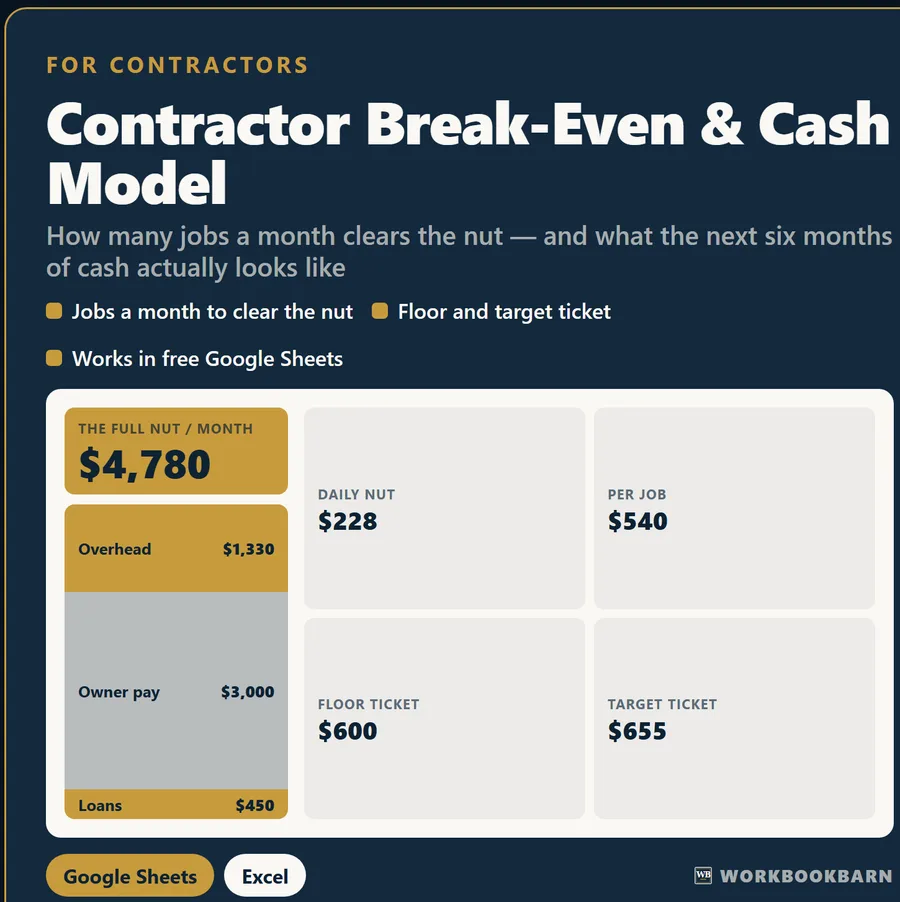
Contractor Break-Even & Cash Model
Run the numbers from this guide yourself — free, in the browser, no sign-up. Keep the full workbook if it earns its place.
Educational estimates only. These calculators and workbooks do the arithmetic on the figures you enter; they are general-purpose tools, not financial, investment, tax, legal, lending, insurance or construction advice, and no result is a quote, an offer, or a guarantee of any outcome. Results depend entirely on your inputs and assumptions. Verify anything you intend to rely on with a licensed professional — a CPA, attorney, lender, licensed contractor, or your own agent. WorkbookBarn and Marcos Gil accept no liability for decisions made using these tools. Marcos Gil is a licensed Kentucky real estate agent (License No. 296259) and is not a lender, CPA or attorney.