The Ledger · Trades
How to Start a Landscaping Business: Costs and the Rate Math
Starting a landscape installation business costs $19,430 to $37,689 in sourced 2026 figures, and the break-even hourly rate on our free kit seed figures is $39.09.
Starting a landscape installation business costs $19,430 to $37,689 in sourced 2026 figures — equipment, a used truck, first-year general liability and launch marketing. But the number that decides whether you keep the business is the other one: the hourly rate that covers your nut. On our free kit’s seed figures, that break-even rate is $39.09 an hour.
Last updated: 2026-09-01
Most people who ask how to start a landscaping business are already good at the work. They can cut a clean bed line, set a base that does not settle, and roll sod that knits. What they are drowning in is the other half of the job — pricing, licensing, and a truck seat full of receipts that never turns into a number. This guide is that half, and every figure below comes from a published source or from the free companion kit you can download and run yourself.
How much does it cost to start a landscaping business?
Landscape installation costs $19,430 at the low end and $37,689 at the high end, counting essential equipment, a used work truck, first-year liability insurance and launch marketing.
That range comes from our Home-Service Startup Costs comparison of 40 trades (last updated 2026-08-30), where every trade is computed the same four ways so the comparison is honest. Landscape installation sits in the upper third — the plate compactor and paver saw that hardscape work demands are what push it past the mowing trades.
Here is the high-end column itemised. These are the exact seed values in the free companion kit’s STARTUP BUDGET tab, each seeded at the top of its published range so the number you start from is a ceiling, not a wish:
| Line item | Seeded at | Published range |
|---|---|---|
| Open utility/landscape trailer | $3,000 | $1,500–$3,000 |
| Hand tools (shovels, rakes, tampers) | $500 | $200–$500 |
| Heavy-duty wheelbarrows (2–3) | $200 | $100–$200 |
| Gas string trimmer | $400 | $200–$400 |
| Backpack leaf blower | $400 | $250–$400 |
| Chainsaw (clearing / tree work) | $500 | $300–$500 |
| Vibratory plate compactor (paver base) | $3,000 | $700–$3,000 |
| Wet tile/paver saw | $939 | $70–$939 |
| Gas hedge trimmer | $400 | $200–$400 |
| PPE / safety gear | $150 | $50–$150 |
| Essential equipment subtotal | $9,489 | $3,570–$9,489 |
| Used work pickup (rated to tow the trailer) | $25,000 | — |
| General liability, year one | $1,200 | — |
| Launch marketing | $2,000 | — |
| Total startup | $37,689 | — |
| Reserve (10% of everything above) | $3,768.90 | — |
| Cash needed to start | $41,457.90 | — |
Two things are worth noticing. The truck is two-thirds of the total, so buying versus borrowing one changes this business more than every tool decision combined. And the 10% reserve is the line most first-year owners skip — it is the difference between a slow February and a closed business.
What equipment do you actually need on day one?
Ten items cover a first install job: trailer, hand tools, wheelbarrows, string trimmer, backpack blower, chainsaw, plate compactor, wet paver saw, hedge trimmer and PPE.
The kit seeds that list at $9,489 because it uses the top of every published range. The low end of the same list is $3,570 — and the gap between those two numbers is almost entirely the compactor and the paver saw. Both are rentable by the day at most equipment yards, which is why the low column is reachable: rent the two expensive machines for the jobs that need them, and buy them when the calendar shows you using them every week rather than before.
What hourly rate do you have to charge to break even?
Your break-even hourly rate is the fully burdened cost of an hour of labour plus your fixed overhead, divided by the billable hours you actually sell in a month.
This is the arithmetic the free contractor break-even calculator runs, and it is the same formula on the PRICING tab of the landscape kit. Written out:
Billable hours per month = billable hours per week × 4.33

Monthly nut           = wage × (1 + burden%) × hours + fixed overhead
Break-even hourly     = monthly nut ÷ hours
Rate at target margin = break-even hourly ÷ (1 − target margin)
The 4.33 is not a fudge — it is 52 weeks divided by 12 months. Most owners quietly assume four weeks and then wonder why the month never balances.
A worked example with the kit’s seed figures
The kit ships seeded with a wage of $28.09 per hour, a payroll burden of 25%, 30 billable hours a week, $517 of fixed monthly overhead (insurance, marketing and software) and a 35% target margin. Run those through the formulas above:
- Billable hours per month = 30 × 4.33 = 129.9 hours
- Monthly nut = $28.09 × 1.25 × 129.9 + $517 = $5,078.11
- Break-even hourly = $5,078.11 ÷ 129.9 = $39.09
- Rate at a 35% margin = $39.09 ÷ 0.65 = $60.14
So an hour billed at $39.09 pays for itself and nothing else. Every dollar of profit in this example lives in the $21.05 between break-even and the target rate. Change any one of the five inputs — take a week off, add a phone plan, drop to 24 billable hours — and both numbers move. That is the whole reason to run it as a formula instead of picking a round number and hoping.
How many jobs a month does it take to clear the nut?
Divide your monthly nut by the gross profit of an average job — the average ticket multiplied by your target margin. The answer is usually smaller than owners expect.
Jobs per month to clear the nut = monthly nut ÷ (average ticket × target margin)The kit seeds an average install ticket of $2,996, taken as the mean of the typical-job highs in the book. With the $5,078.11 nut and a 35% margin, that is $5,078.11 ÷ ($2,996 × 0.35) = $5,078.11 ÷ $1,048.60 = 4.84 jobs — call it five installs a month to cover everything before a dollar of profit exists.
Five is a useful number to carry around. It turns “am I busy enough?” into a question you can answer on the sixth of the month instead of at tax time.
Is $100 an hour too much to charge for landscaping?
An hourly rate is not high or low in the abstract — it is high or low against your own break-even. That is the only comparison that carries information.
On the seed figures above, $39.09 is the floor and $60.14 hits a 35% margin. A shop with a second truck, a foreman and a real yard has a very different floor, and $100 can be its break-even rather than its prize. Run your own five inputs through the break-even calculator before arguing about the number with anyone, including yourself. In my own trade — I run a roofing company in Kentucky — the owners who lose money are almost never the ones charging too little on purpose. They are the ones who never computed the floor and drifted below it one discount at a time.
What licences and insurance does a landscaping business need?
Requirements are set by your state and locality rather than nationally, and installation work such as hardscape and irrigation is regulated more often than mowing.
The U.S. Small Business Administration states that most small businesses need a combination of licenses and permits from both federal and state agencies, and that the requirements and fees vary based on your business activities, location and government rules — which is why no guide can hand you your licence list, only tell you where to look it up. Your business structure is a separate decision: the Internal Revenue Service sets out the structures available, including sole proprietorship, partnership, corporation and limited liability company.
The $1,200 general liability line in the budget above is a first-year planning figure, not a quote. Get the real one before writing it into a plan, because it also sits inside the overhead input that sets your break-even rate.
Is landscape installation a better business to start than lawn care?
Lawn care is cheaper to enter and installation carries the bigger ticket — the two trades solve different problems, and the startup figures show the trade-off plainly.
On the same computed basis, lawn care starts at $7,688 to $21,349 against landscape installation’s $19,430 to $37,689. Lawn care buys recurring revenue on a lighter equipment load; installation buys a four-figure average ticket and a seasonality you have to plan around. Plenty of shops run both, which is why the free kits are separate — see the whole 40-trade comparison if you are still choosing, or the cleaning startup guide for the lowest-capital route of all.
Where do you get the plan and the spreadsheet?
The free companion kit holds every formula on this page, seeded and ready to type over; the book holds the 13-chapter plan those worksheets belong to.
- Free Landscape Installation companion kit — the Excel model with the STARTUP BUDGET and PRICING tabs used throughout this guide, plus printable worksheets.
- Landscape Installation Business Startup Plan & Workbook — the 142-page book: licensing, startup costs, bidding, offers, leads and the plan you fill in.
- Contractor break-even calculator — the rate math in your browser, nothing to download.
Frequently asked questions
Can you start a landscaping business with no money?
Not on the figures above, but the gap is smaller than the totals suggest. The truck is $25,000 of the $37,689 high end, and the compactor and paver saw are another $3,939 — all three can be rented or borrowed for a first job. Strip the budget to hand tools, a trimmer, a blower, PPE and insurance and the day-one number lands in the hundreds rather than the tens of thousands. What cannot be skipped is liability cover and whatever licence your state requires.
How is landscape installation different from lawn care?
Installation is project work — beds, sod, patios, plantings, drainage — priced per job with a four-figure average ticket. Lawn care is recurring maintenance priced per visit or per month. The equipment overlaps at the small-tool end and diverges sharply at the top: compaction and cutting equipment for installs, mowers and route capacity for maintenance. Startup cost reflects it: $7,688–$21,349 for lawn care against $19,430–$37,689 for installation.
Where do the numbers in this guide come from?
The startup ranges come from our 40-trade comparison page, which computes every trade identically from published, cited sources and carries its own last-updated date. The seed figures in the pricing example — wage, burden, billable hours, overhead, margin and average ticket — are the values shipped in the free Landscape Installation companion kit, and the budget totals reconcile exactly to the comparison page. Nothing here is a quote or an estimate for your market; they are starting values you type over.
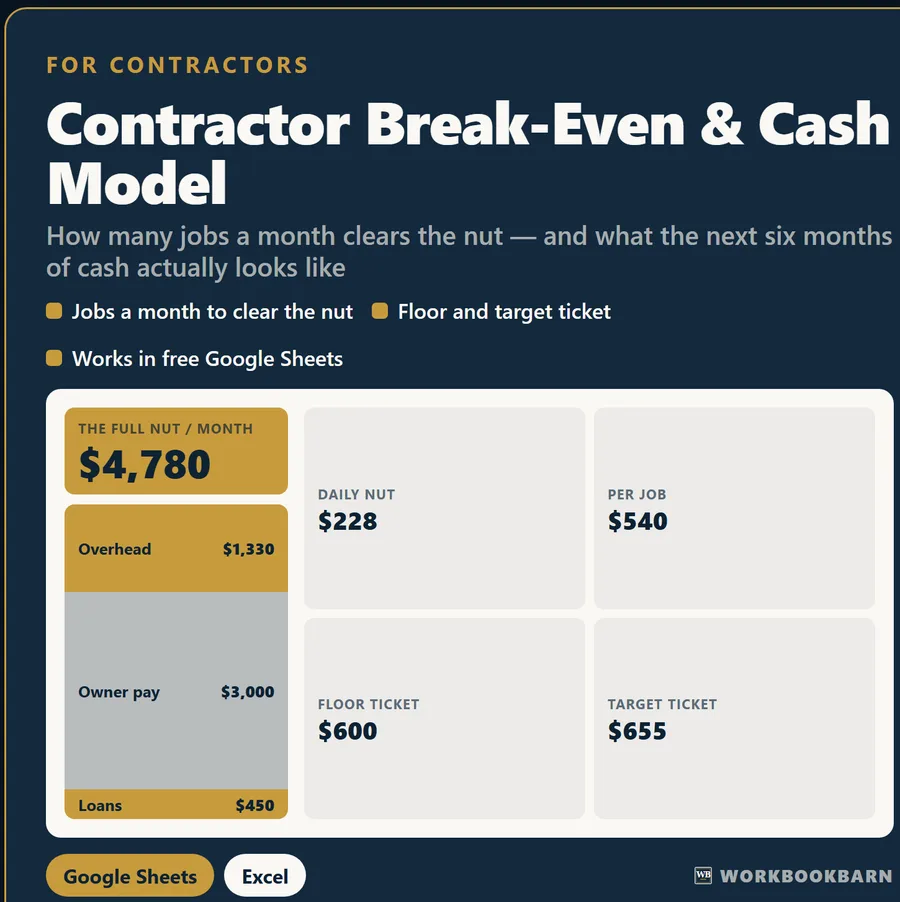
Contractor Break-Even & Cash Model
Run the numbers from this guide yourself — free, in the browser, no sign-up. Keep the full workbook if it earns its place.
Educational estimates only. These calculators and workbooks do the arithmetic on the figures you enter; they are general-purpose tools, not financial, investment, tax, legal, lending, insurance or construction advice, and no result is a quote, an offer, or a guarantee of any outcome. Results depend entirely on your inputs and assumptions. Verify anything you intend to rely on with a licensed professional — a CPA, attorney, lender, licensed contractor, or your own agent. WorkbookBarn and Marcos Gil accept no liability for decisions made using these tools. Marcos Gil is a licensed Kentucky real estate agent (License No. 296259) and is not a lender, CPA or attorney.