The Ledger · Trades
How to Start an HVAC Business: Cost, Rate and the 608 Rule
Starting an HVAC business costs $21,357 to $34,747 in sourced figures, and the break-even hourly rate on the kit’s seeded numbers is $47.56.
Starting an HVAC business costs $21,357 to $34,747 in sourced 2026 figures — eleven refrigerant and electrical tools, a used pickup, first-year general liability and launch marketing. On the free kit’s seeded inputs the break-even rate is $47.56 an hour, and refrigerant work requires EPA Section 608 certification before the first call.
Last updated: 2026-09-14
Good at the work, bad at the business. In HVAC that gap has a particular shape: the tech who finds the leak everyone else missed is often the same one with a truck seat full of receipts and no idea what to charge for a service call once they are the one paying the insurance. Search this question and you get step lists — get licensed, form an LLC, buy a van, build a website. All true, all free everywhere, and none of it puts a number on the page. The guides ranking today quote “$2,000 to $10,000” or “$3,000 to $12,000” and stop; not one of them itemises the tools or runs the arithmetic that turns a cost stack into a rate. This guide does that half — the itemised stack, the break-even hourly formula, the jobs-per-month count, and the federal certification that decides which of your tools you may legally use — from the same sourced dataset behind our startup-cost comparison for 40 trades and the same arithmetic that runs inside the free calculator.
How much does it cost to start an HVAC business?
Between $21,357 and $34,747, computed as itemised day-one equipment plus a used pickup plus first-year general liability insurance plus a launch marketing budget.
That is a sum of four components, added the same way for HVAC as for the other 39 trades on the comparison page — not a national average. The high column below is what the free companion kit seeds into its Startup Budget tab, deliberately the high end of every published range, so your own quotes typed over it can only move the total down.
| Component | Seeded figure (published high end) |
|---|---|
| Essential equipment, day one (11 tools — see the next section) | $4,931 |
| Used half-ton pickup (2019 model, roughly six to seven years old) | $22,500 |
| General liability insurance, year one | $2,316 |
| Launch marketing | $5,000 |
| Total to start — HVAC, high | $34,747 |
| Same four components, low end (comparison page) | $21,357 |
| Plus the kit’s 10% reserve line | $3,474.70 |
| Cash needed to start, high column with reserve | $38,221.70 |
The proportions are the story. The truck is $22,500 — 64.8% of the stack on its own. Equipment is $4,931, or 14.2%, which sounds small until you set it beside a trade like painting, where the whole day-one tool list is $686. In HVAC the tools alone clear the “$3,000 to start” figure other guides quote, before a truck, a policy or a single ad.
What equipment do you actually need on day one?
Eleven tools, $2,721 to $4,931 across their published ranges — and six of the eleven exist to measure, move, evacuate or recover refrigerant.
| Tool | Seeded (high) | Published range |
|---|---|---|
| Refrigerant recovery / fast-evacuation equipment | $1,116 | $900–$1,116 |
| HVAC digital clamp meter / multimeter | $600 | $350–$600 |
| Digital micron vacuum gauge | $550 | $193–$550 |
| 2-stage refrigerant vacuum pump (5–7 CFM) | $526 | $327–$526 |
| Electronic refrigerant leak detector | $500 | $228–$500 |
| Brazing / soldering torch kit | $500 | $200–$500 |
| Flaring tool kit | $379 | $125–$379 |
| Digital / analog refrigerant manifold gauge set | $350 | $241–$350 |
| Refrigerant charging hose set | $200 | $102–$200 |
| Refrigerant tubing cutter | $150 | $35–$150 |
| Duct sealant and foil tape starter kit | $60 | $20–$60 |
| Total, day-one equipment | $4,931 | $2,721–$4,931 |
Group the list and it tells you what the job is. The six refrigerant-circuit tools — recovery equipment, micron gauge, vacuum pump, leak detector, manifold gauges and charging hoses — add up to $3,242, or 65.7% of the tool budget, and the single biggest line is the recovery machine at $1,116. Three more (flaring kit, tubing cutter, torch) are line-set work at $1,029. The clamp meter covers the electrical half of every diagnosis. What is absent is just as telling: no condensers, furnaces, line sets or refrigerant. Equipment and materials are billed to the job, not to the startup, which is why they belong in the ticket rather than in this table.
What does an hour have to bring in before you make a dollar?
$47.56 an hour on the kit’s seeded inputs — the floor that covers wage, payroll burden and fixed overhead, and returns exactly zero profit.
This is the formula the free calculator runs, written out rather than described. Four inputs set the rate; a fifth and sixth set the job count:
Billable hours per month = billable hours per week x 4.33
Monthly nut             = wage x (1 + burden %) x hours per month + fixed overhead
Break-even hourly rate  = monthly nut / hours per month
Rate at target margin   = break-even hourly rate / (1 - target margin)
Jobs a month to clear the nut = monthly nut / (average ticket x target margin)
Worked on the figures the HVAC kit ships with — wage $32.75 an hour, burden 25%, 30 billable hours a week, $860 a month fixed overhead, 35% target margin, $2,871 average ticket:
| Step | Arithmetic | Result |
|---|---|---|
| Billable hours per month | 30 × 4.33 | 129.9 hours |
| Monthly nut | $32.75 × 1.25 × 129.9 + $860 | $6,177.78 |
| Break-even hourly rate | $6,177.78 ÷ 129.9 | $47.56 |
| Rate at a 35% margin | $47.56 ÷ 0.65 | $73.17 |
| Jobs a month to clear the nut | $6,177.78 ÷ ($2,871 × 0.35) | 6.15 jobs |
Set that beside the painting walkthrough, which runs the identical formulas, and one line explains the whole difference. HVAC’s seeded overhead is actually lower — $860 a month against painting’s $970 — yet its floor is $47.56 against $40.77, because the wage line is $32.75 against $26.64. In a licensed, certified trade the labour hour is the expensive input, so a rate copied from a general handyman or a painter is under water before the first callback. And 6.15 jobs a month rests on a $2,871 average ticket; HVAC work swings between a diagnostic call and a full system change-out, so the mix you actually book decides the count. Run your own overhead through the free break-even calculator, or keep the monthly version in the Contractor Break-Even & Cash Model workbook, before you print a rate card.
Do you need a licence or certification to start an HVAC business?
State contractor licensing varies, but one federal rule applies everywhere: technicians who service or dispose of equipment that could release refrigerant must hold EPA Section 608 certification.
The United States Environmental Protection Agency states that its regulations under Section 608 of the Clean Air Act require technicians who maintain, service, repair or dispose of equipment that could release refrigerants into the atmosphere to be certified; that certification means passing an EPA-approved test given by an EPA-approved certifying organization; that there are four types — Type I for small appliances, Type II for high- or very high-pressure appliances, Type III for low-pressure appliances, and Universal for all types; and that Section 608 credentials do not expire (retrieved 2026-09-14). A second EPA page, on the refrigerant sales restriction, states that only EPA-certified technicians are allowed to purchase refrigerant, with limited exceptions, and only for the appliances their certification covers (retrieved 2026-09-14).
Read those two rules against the tool table and the order of operations writes itself. $3,242 of the $4,931 tool budget is refrigerant-circuit equipment, and the certification is what makes it usable on a paying job — and what lets you buy the refrigerant to charge a system at all. Certify first, then buy. The state contractor licence is a separate gate — where a state has one — and its rules and fees differ so much from state to state that the Startup Budget seeds licences and permits at $0 rather than at a made-up national figure: a single number would be wrong nearly everywhere. Take your figure from your own state licensing board (the book’s chapter 4 carries the state table) and type it into the blank line before you decide what you need in the bank.
What do you set aside for self-employment tax?
Plan around the self-employment tax rate of 15.3%, which the Internal Revenue Service states is 12.4% for Social Security plus 2.9% for Medicare (retrieved 2026-09-14).
It is not inside the $47.56. The break-even rate pays the wage, the burden and the overhead; self-employment tax and income tax come out of whatever is left above it, which is one more reason the gap up to $73.17 is not padding. Income tax varies too much by situation for anyone to put an honest single number on a page, so the workbook leaves it as a line you fill in with a CPA rather than a figure we invent for you. This is a planning tool, not tax advice.
What is actually in the plan?
The free HVAC companion kit is the Excel financial model this guide was computed from: a Startup Budget tab seeded with the published high end of every range, a Pricing tab carrying the break-even formulas above with the arithmetic live, a twelve-month forecast with this trade’s seasonality, and every worksheet from the book as a printable PDF. It costs nothing, it opens in free Google Sheets, and it works without the book.
The HVAC Business Startup Plan & Workbook is a 142-page PDF ebook at $14.99 on Etsy — the chapter-by-chapter plan you fill in, covering licensing, insurance, pricing and leads. There is no $997 course at the end of this page, no webinar, no upsell ladder. Every figure in the book cites a published source and every formula in the kit is machine-checked against the spreadsheet it came from, which is the same check that produced the numbers in the tables above.
Common questions
Can I start an HVAC business for $3,000 like other guides say?
Not with the tools on this list. The eleven day-one tools run $2,721 at the low end of their published ranges and $4,931 at the high end, before a truck, a policy or any marketing. If you already own a pickup, the seeded day-one figure falls from $34,747 to $12,247; below that you are choosing whether to go without general liability ($2,316 seeded, year one) or launch marketing ($5,000 seeded), and both are decisions with consequences rather than savings.
Do I need Section 608 certification before I buy tools?
You can buy the tools; you cannot legally use them for the work they exist for. EPA rules require certification for technicians who maintain, service, repair or dispose of equipment that could release refrigerant, and limit refrigerant purchases to certified technicians, with limited exceptions. EPA itself does not issue certification cards — the test is given by an EPA-approved certifying organization — and the credential does not expire once earned.
Is $47.56 an hour really the floor?
It is the floor for the seeded inputs and nothing else: $32.75 wage, 25% burden, 30 billable hours a week, $860 monthly overhead. Every one of those is a cell you type over, and the answer moves the moment you do. That is why the number is published with its formula and inputs attached rather than as a national average — put your own overhead into the free calculator before you quote anyone.
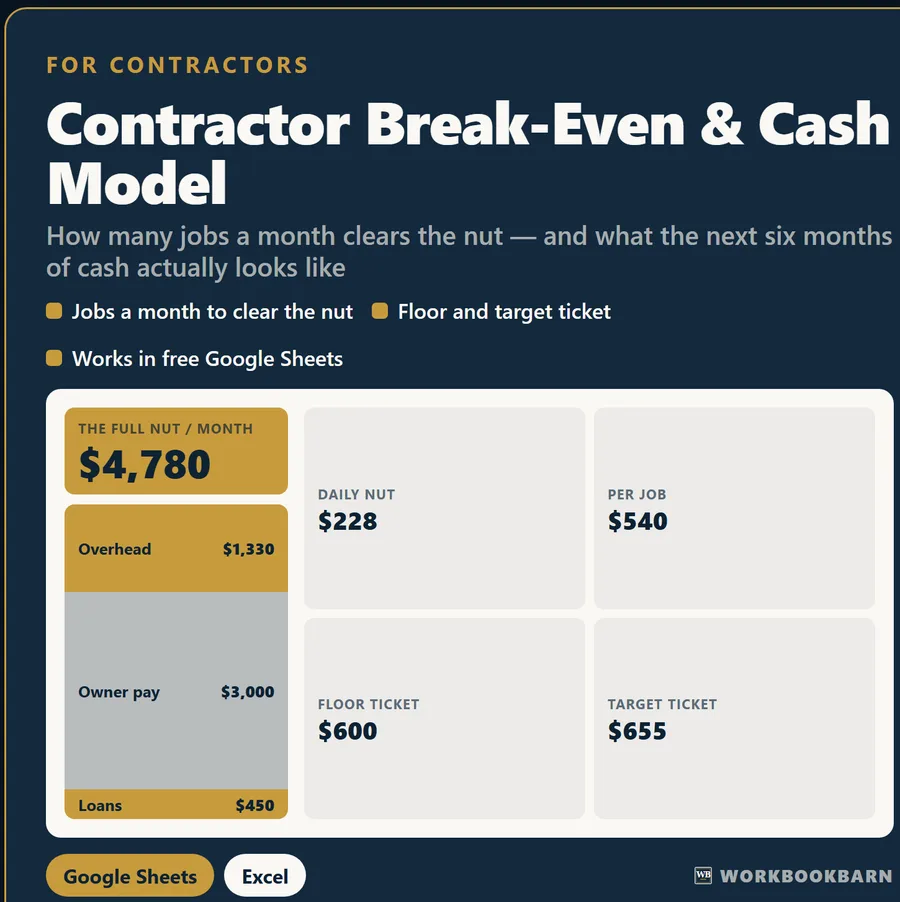
Contractor Break-Even & Cash Model
Run the numbers from this guide yourself — free, in the browser, no sign-up. Keep the full workbook if it earns its place.
Educational estimates only. These calculators and workbooks do the arithmetic on the figures you enter; they are general-purpose tools, not financial, investment, tax, legal, lending, insurance or construction advice, and no result is a quote, an offer, or a guarantee of any outcome. Results depend entirely on your inputs and assumptions. Verify anything you intend to rely on with a licensed professional — a CPA, attorney, lender, licensed contractor, or your own agent. WorkbookBarn and Marcos Gil accept no liability for decisions made using these tools. Marcos Gil is a licensed Kentucky real estate agent (License No. 296259) and is not a lender, CPA or attorney.