The Ledger · Trades
Roof Pitch Factor Chart and How to Use It on a Takeoff
A roof pitch factor is the square root of 1 plus (rise divided by 12) squared — the multiplier that turns a flat footprint area into real roof surface.
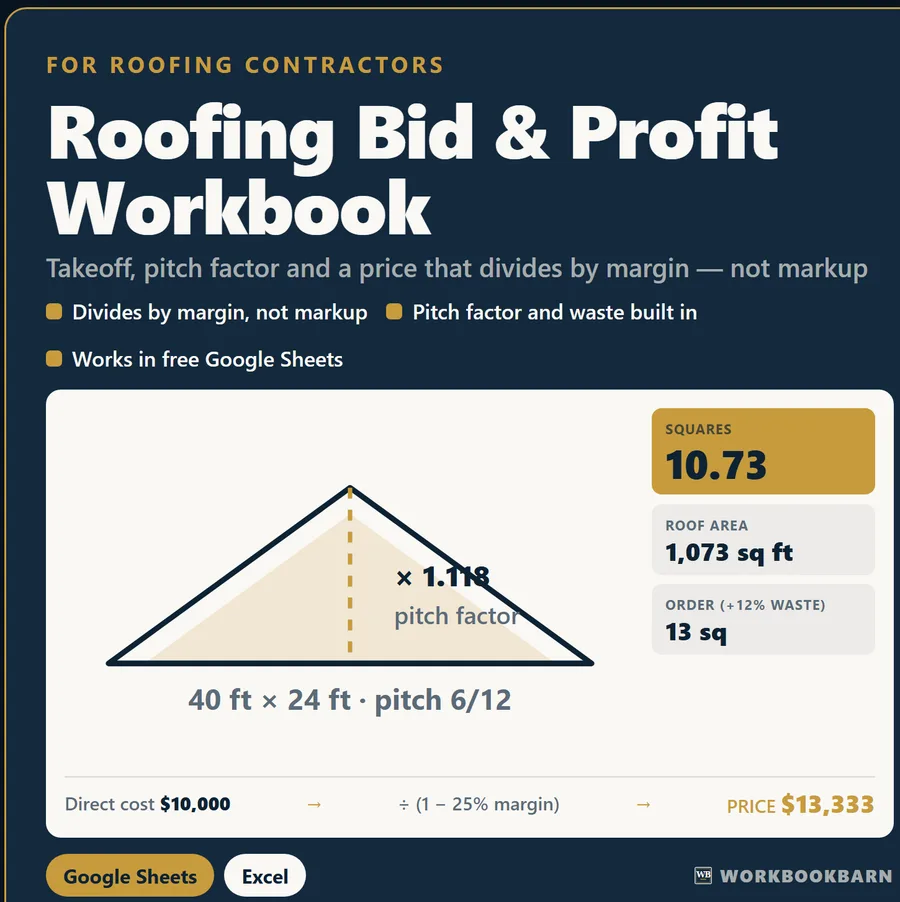
A roof pitch factor is √(1 + (rise ÷ 12)²) — the number you multiply a flat footprint area by to get the real roof surface. A 6/12 pitch factor is 1.118, so a 40 ft × 24 ft plane that measures 960 sq ft on the ground is 1,073.31 sq ft of roof. Getting that one multiplier wrong is how a bid ends up short before anybody has argued about price.
What is a roof pitch factor?
It is the slope multiplier that converts the horizontal area under a roof plane into the sloped area you actually have to cover.
Pitch is written as rise over a 12-inch run: 6/12 means the roof climbs 6 inches for every 12 inches it travels sideways. That makes a right triangle with a run of 12 and a rise of 6, and the sloped edge is the hypotenuse. Divide the hypotenuse by the run and you get a number slightly larger than 1 — the pitch factor, also sold under the names slope factor, roof multiplier and pitch multiplier. They are all the same arithmetic.
This is the formula the free Roofing Bid & Profit calculator runs in its Takeoff table, written exactly as the tool states it:
pitch factor = SQRT(1 + (rise / 12)^2)

angle in degrees = DEGREES(ATAN(rise / 12))

actual sq ft    = length x width x pitch factor
squares         = actual sq ft / 100
Two things fall out of that formula that a chart alone will not tell you. The factor never depends on the size of the roof, only on the slope — so it is a constant you can look up once and reuse. And it is always greater than 1 except on a dead-flat roof, which is why a footprint measurement is always the low number.
Roof pitch chart: factor and angle for every pitch
Every row below is computed from the formula above, carried to six decimals and then shown rounded, so you can check any line yourself.
| Pitch (rise/12) | Pitch factor (6 dp) | Factor rounded | Angle | Area added |
|---|---|---|---|---|
| 1/12 | 1.003466 | 1.00 | 4.8° | 0.3% |
| 2/12 | 1.013794 | 1.01 | 9.5° | 1.4% |
| 3/12 | 1.030776 | 1.03 | 14.0° | 3.1% |
| 4/12 | 1.054093 | 1.05 | 18.4° | 5.4% |
| 5/12 | 1.083333 | 1.08 | 22.6° | 8.3% |
| 6/12 | 1.118034 | 1.12 | 26.6° | 11.8% |
| 7/12 | 1.157704 | 1.16 | 30.3° | 15.8% |
| 8/12 | 1.201850 | 1.20 | 33.7° | 20.2% |
| 9/12 | 1.250000 | 1.25 | 36.9° | 25.0% |
| 10/12 | 1.301708 | 1.30 | 39.8° | 30.2% |
| 11/12 | 1.356568 | 1.36 | 42.5° | 35.7% |
| 12/12 | 1.414214 | 1.41 | 45.0° | 41.4% |
| 14/12 | 1.536591 | 1.54 | 49.4° | 53.7% |
| 16/12 | 1.666667 | 1.67 | 53.1° | 66.7% |
| 18/12 | 1.802776 | 1.80 | 56.3° | 80.3% |
Notice how fast the last column climbs. At 4/12 the slope adds 5.4% to the area and you can almost eyeball it. At 9/12 it adds exactly a quarter — a 2,000 sq ft footprint is 2,500 sq ft of roof, and 9/12 is where the calculator’s own price book starts its steep-pitch surcharge line. At 12/12 the slope has added 41.4% and a footprint number is not even a useful estimate any more.
How do you convert a roof pitch to degrees?
Take the arctangent of the rise divided by 12. A 6/12 roof is arctan(0.5), which is 26.6°; a 12/12 roof is arctan(1), exactly 45°.
The degrees column is the one most people actually want when they are reading a drawing or setting a tool, and it is worth knowing that the angle and the factor are two different functions of the same slope. The angle grows roughly in a straight line as the pitch rises; the factor does not. Between 1/12 and 6/12 the angle more than quintuples while the factor moves only from 1.003 to 1.118. Do not try to interpolate one from the other — compute both from the rise.
How do you use the pitch factor on a real takeoff?
Measure the footprint of each roof plane on the ground or on the drawing, multiply each one by its own pitch factor, add the planes, then divide by 100.
Here is the chain from the seed figures the Roofing Bid & Profit Workbook ships with, every one of them read from its test ledger rather than typed in by hand. The first plane is 40 ft by 24 ft at 6/12:
- Takeoff E6 — pitch factor 6/12: 1.12. The cell displays two decimals but calculates on the full 1.118034.
- Takeoff F6 — 40 × 24 × 1.118 sq ft: 1,073.31. The footprint is 960 sq ft; the slope adds 113.31.
- Takeoff G6 — squares for plane 1: 10.73. That is 1,073.31 divided by 100.
- Takeoff F47 — measured squares total: 10.73. One plane in the seed file, so the total matches the plane.
- Takeoff F49 — squares to ORDER: 13. Measured squares carried through the waste factor and rounded up to whole squares.
That last jump is where the money is. The calculator ships with its waste factor set to 0.15 for a cut-up roof, so 10.73 squares becomes 12.34, and because nobody sells a third of a square it rounds up to 13. You measured 10.73 and you are buying 13 — 21% more material than the roof surface, and 35% more than the footprint you would have quoted if you had skipped the pitch factor entirely. Run your own numbers in the free calculator and the Takeoff table will show you the same four columns.
Does the pitch factor change the price, or just the quantity?
Only the quantity. The factor multiplies area, never dollars — pitch reaches the price through the squares it adds and through a separate steep-pitch line item.
This is the part the pitch charts leave out, and it is where a bid gets lost. Once the takeoff is right, the price is a second piece of arithmetic that has nothing to do with slope. From the same seed ledger: direct cost lands at 3,750, sales tax on material adds 225 for a total cost of 3,975, overhead at 12% of cost adds 477 for a cost-plus-overhead figure of 4,452, and the bid price comes out at 5,936 with 1,484 of profit and a margin check reading 25.0% — equal to the target, which is the whole point of the check.
The bid divides rather than adds:
bid price = (cost + overhead) / (1 - target margin)
          = 4,452 / (1 - 0.25)
          = 5,936
Add 25% instead of dividing by 0.75 and you get 4,452 × 1.25 = 5,565. Check the margin on that: (5,565 − 4,452) ÷ 5,565 = 20.0%. Same intention, five points of margin gone, and on this one roof it is the difference between 1,484 and 1,113 of profit. If that distinction is new, the longer version is in why a 40% markup is only a 28.6% margin, and the break-even side of it is in how many jobs a month it takes to break even.
Where is the line between a low-slope roof and a steep roof?
For fall-protection purposes the dividing line is 4 in 12, and it is written into federal regulation rather than left to the trade to argue about.
In the definitions at 29 CFR 1926.500(b), the Occupational Safety and Health Administration defines a low-slope roof as “a roof having a slope less than or equal to 4 in 12 (vertical to horizontal)” and a steep roof as “a roof having a slope greater than 4 in 12” (read 19 October 2026). The two categories carry different requirements in 1926.501(b)(10) and (b)(11), so 4/12 is a real boundary on a schedule and not just a number on a chart. It is also the point where the pitch factor crosses 1.054 — a useful coincidence if you want one line to remember.
This is general information about how the slope categories are defined, not a safety plan. Check the current standard and your state plan before you schedule anything.
What about hips and valleys?
Area still uses the pitch factor. Rafter length along a hip or valley does not, because that member runs diagonally in plan and needs its own multiplier.
A hip or valley rafter on equal pitches travels at 45° across the footprint, so its run per foot of common run is √2 rather than 1. Put that into the same hypotenuse arithmetic and the length factor becomes:
hip / valley length factor = SQRT(2 + (rise / 12)^2)

6/12  ->  SQRT(2.25)  =  1.500
8/12  ->  SQRT(2.444) =  1.563
12/12 ->  SQRT(3)     =  1.732
Keep the two apart. The pitch factor answers how much surface you are covering, which is what the material order and the squares depend on. The hip factor answers how long a stick of lumber or a run of valley metal has to be. A takeoff built on plane areas — which is how the Takeoff table above works — needs the first number for every plane and the second only when you are ordering linear material.
Frequently asked questions
Is it safe to round the pitch factor to two decimals?
Usually, but know what it costs. On the 960 sq ft seed plane, 1.12 gives 1,075.20 sq ft against 1,073.31 from the full 1.118034 — under two square feet. The error is proportional, so it stays near 0.2% whatever the roof size, and it vanishes entirely once the waste factor rounds you up to whole squares. The workbook displays two decimals and calculates on the full value, which is the right order to do it in.
Do I apply the pitch factor to the footprint of the house or to each roof plane?
Each plane, separately, with its own factor. A house with a 6/12 main roof and a 3/12 porch has two different multipliers, and one building-wide average will be wrong on both. The Takeoff table carries six plane rows for exactly this reason: length, width and pitch per row, factor computed per row.
Why is “squares to order” so much bigger than the squares I measured?
Two reasons stack. The waste factor adds for cuts, starter, ridge and mistakes, and then the result rounds up to a whole square because that is the unit material is sold in. In the seed file 10.73 measured squares becomes 13 ordered at a 0.15 waste factor. Lower the waste factor to 0.10 for a simple gable and the same roof orders 12.
Every figure above that came from the Roofing Bid & Profit Workbook ($24.99, Google Sheets and Excel in one purchase) is a cell from its test ledger: the workbook was rebuilt in a calculation engine and 28 figures were compared against values worked out independently in code from the same seed inputs. The pitch factor is not a chart you have to trust in that file — it is a formula you can open and read.
Roofing Bid & Profit Workbook
Run the numbers from this guide yourself — free, in the browser, no sign-up. Keep the full workbook if it earns its place.
Educational estimates only. These calculators and workbooks do the arithmetic on the figures you enter; they are general-purpose tools, not financial, investment, tax, legal, lending, insurance or construction advice, and no result is a quote, an offer, or a guarantee of any outcome. Results depend entirely on your inputs and assumptions. Verify anything you intend to rely on with a licensed professional — a CPA, attorney, lender, licensed contractor, or your own agent. WorkbookBarn and Marcos Gil accept no liability for decisions made using these tools. Marcos Gil is a licensed Kentucky real estate agent (License No. 296259) and is not a lender, CPA or attorney.