The Ledger · Trades
Markup vs Margin: Why a 40% Markup Is Only a 28.6% Margin
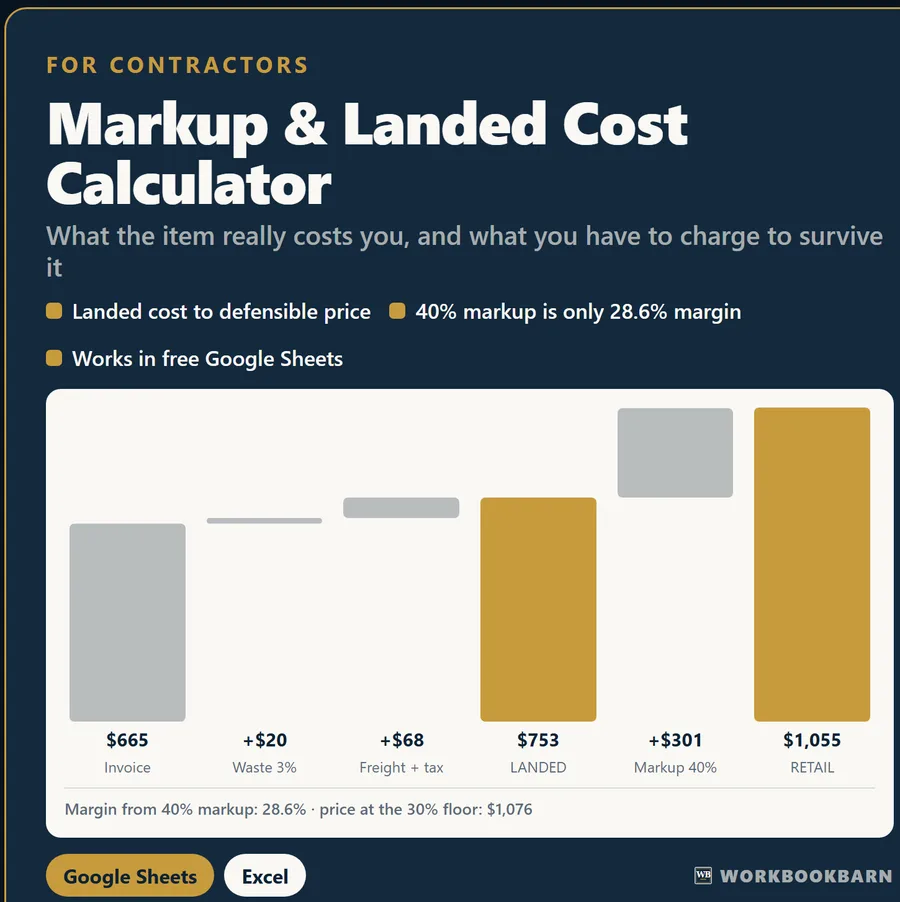
A 40% markup on a $753.49 landed cost prices the item at $1,054.88 and keeps $301.39 - a 28.6% margin, not 40%; a 30% margin needs a 42.9% markup.
Markup and margin are two different fractions of two different numbers, which is why a 40% markup does not leave you 40%. Add 40% to a landed cost of $753.49 and you charge $1,054.88, keep $301.39, and that is a 28.6% margin. To actually keep 30%, the markup has to be 42.9%.
Almost every pricing argument in a trades business is really this arithmetic argument wearing work boots. Somebody is good at the work and running the numbers in their head at the supply house counter, and “I put forty on it” feels like it means forty. It doesn’t. The gap is small enough to survive one job and big enough to eat a year, so it is worth ten minutes to nail down once.
Every dollar figure below is a seed value from the Markup & Landed Cost Calculator‘s PRICE ONE ITEM sheet, and you can run your own numbers through the same formulas in the free markup and landed cost calculator.
What is the difference between markup and margin?
Markup is profit divided by what the item cost you. Margin is that same profit divided by what the customer paid. Same dollars on top, different number underneath.
That is the whole trick. The dollar of profit never moves. Only the denominator moves, and because the price is always bigger than the cost, the margin percentage is always smaller than the markup percentage. They agree only at zero.
markup %  =  (price - cost) / cost
margin %  =  (price - cost) / price

price     =  cost x (1 + markup %)
margin    =  markup / (1 + markup)
markup    =  margin / (1 - margin)
Those last two lines are the conversion pair, and they are the only two formulas you have to remember. Everything else in this guide is those two lines with real money in them.
Why is a 40% markup only a 28.6% margin?
Because the 40% is measured against cost and the margin is measured against the larger price. Dividing the same $301.39 of profit by $1,054.88 instead of $753.49 gives 28.6%.
Here is the chain exactly as the workbook runs it, using its seed figures. The material lands at $684.95 after waste, sales tax adds $42.54, and with freight and handling the item’s landed cost is $753.49 — $88.49 above the invoice price before anyone has made a dime. Then the markup goes on:
landed cost            753.49
x (1 + 0.40)
retail                1,054.88     (F11)
- landed cost           753.49
gross profit            301.39     (F12)

301.39 / 1,054.88  =    28.6%      (F13)  <-- margin
301.39 /   753.49  =    40.0%              <-- markup
More than eleven points of difference on one line item. Run that across a job full of line items and the number you thought you were making and the number you are actually making stop being neighbours.
What markup do you need to hit a 30% margin?
You need 42.9%. Set a 30% margin floor and the formula markup = margin / (1 - margin) returns 0.30 / 0.70, which is 42.857%, rounded to 42.9%.
In the workbook that floor is an input cell, seeded at 30.0%, and the sheet answers with the two numbers you actually need at the counter: the price the floor requires and how far short today's price falls. At a 30% floor the same item has to sell for $1,076.41, and the 40% markup price of $1,054.88 leaves a $21.53 gap.
Twenty-one dollars. That is the part people wave off, and it is exactly the part that compounds — it is per item, on every item, on every job, all year.
What is the markup-to-margin conversion chart?
This table converts in both directions: what a markup actually keeps you, and what markup a target margin actually demands. Every row is the two formulas above.
| If you add this markup | You keep this margin | To make that number a margin, mark up |
|---|---|---|
| 20% | 16.7% | 25.0% |
| 25% | 20.0% | 33.3% |
| 30% | 23.1% | 42.9% |
| 33% | 24.8% | 49.3% |
| 40% | 28.6% | 66.7% |
| 50% | 33.3% | 100.0% |
Read the bottom right cell twice. A 50% margin is not a 50% markup. It is a double it markup.
Does landed cost change the answer?
It changes what you multiply. Marking up the invoice price instead of the landed cost silently hands the customer your waste, your sales tax and your freight for free.
In the seed example the invoice number and the real number are $88.49 apart. Mark up the invoice price by 40% and you are short before the margin conversion even starts; then the conversion takes another bite. Two separate leaks, in the same line item, both invisible on the estimate.
This is also why "what percentage should I charge" is the wrong first question. The right first question is what did this actually cost me by the time it was on the truck. Waste factor, tax, freight, handling. Then the percentage has something true to stand on.
How do you check a whole price book at once?
You run every line through the same two formulas and sort by the gap column, because the biggest leaks are rarely on the items you think about most.
The workbook's PRICE BOOK sheet does this row by row. Its seed rows show the pattern clearly: row 5 prices at $982.02 for a 28.6% margin and a $20.04 gap to the floor, row 6 sits $23.00 short, and row 12 — a small $177.07 item — is only $3.61 short. Small item, small gap, and it is the one you sell forty times a month.
The 28.6% repeating down the column is the tell. When every row lands on the same margin, nobody is pricing per item — one blanket markup is being applied to everything, and the floor is being missed everywhere at once.
Should you quote in markup or margin?
Price with markup because it is the only one you can multiply at the counter, and measure with margin because that is the number your books, your lender and your tax return speak.
Margin is not an invented management metric. The IRS computes it the same way on the way to your Schedule C: subtract cost of goods sold from net receipts to get gross profit, and to sanity-check the result it says to "divide gross profit by net receipts" — profit over revenue, which is margin. That is straight out of IRS Publication 334 (Tax Guide for Small Business, Figuring Gross Profit; retrieved 2026-09-23).
So markup is the lever and margin is the gauge. Pull the lever, read the gauge. Never assume the two show the same number, because on this item they differ by 11.4 points.
Common questions
Is 20% margin the same as 25% markup?
Yes. Running markup = margin / (1 - margin) on a 20% margin gives 0.20 / 0.80 = 25%. The two describe the same dollars, measured against price and against cost.
How much margin is a 33% markup?
24.8%. markup / (1 + markup) is 0.33 / 1.33 = 24.81%. Not far off a quarter of the price, and more than eight points below the 33% most people assume.
What is a landed cost?
What the item costs you by the time it is usable on your job, not what the invoice said. In the workbook's seed example that means material after waste of $684.95 plus $42.54 of sales tax plus freight and handling, for a landed cost of $753.49 — $88.49 above the invoice price.
Run your own numbers in the free markup and landed cost calculator, or keep the whole thing — price book, margin floor, gap column — in the Markup & Landed Cost Calculator workbook. If you are still building the business around the pricing, the guide to starting a roofing business covers what has to be true before a price book is worth keeping.
Markup & Landed Cost Calculator
Run the numbers from this guide yourself — free, in the browser, no sign-up. Keep the full workbook if it earns its place.
Educational estimates only. These calculators and workbooks do the arithmetic on the figures you enter; they are general-purpose tools, not financial, investment, tax, legal, lending, insurance or construction advice, and no result is a quote, an offer, or a guarantee of any outcome. Results depend entirely on your inputs and assumptions. Verify anything you intend to rely on with a licensed professional — a CPA, attorney, lender, licensed contractor, or your own agent. WorkbookBarn and Marcos Gil accept no liability for decisions made using these tools. Marcos Gil is a licensed Kentucky real estate agent (License No. 296259) and is not a lender, CPA or attorney.