The Ledger · Trades
How to Start a Painting Business: Cost, Rate and the Lead Rule
Starting a painting business costs $17,814 to $28,207 in sourced figures, and the break-even hourly rate on the kit's seeded numbers is $40.77.
Starting a painting business costs $17,814 to $28,207 in sourced 2026 figures — a fifteen-item equipment stack, a used work truck, first-year general liability and launch marketing. The number that decides whether it survives is a different one: the break-even hourly rate, which on the model’s seeded figures is $40.77, and it takes 5.78 jobs a month at a $2,619 ticket to clear the nut.
Last updated: 2026-09-10
Good at the work, bad at the business. Painting is the trade where that gap opens fastest, because the craft has a low equipment barrier and a brutally competitive bid sheet — anyone can buy a brush, so the winner is decided by who knows what an hour has to bring in. Search this question and you get ten-step lists: register an LLC, buy a sprayer, post before-and-afters. All true, all free everywhere, and none of it puts a number on the page. The guides ranking today quote “$1,875 to $4,750” or “$3,000 to $15,000” and stop; not one of them runs the arithmetic that turns a cost stack into a rate. So this guide does the boring half — the itemised stack, the break-even hourly formula, the jobs-per-month count, and the one federal certification most painting startup guides never mention — from the same sourced dataset behind our startup-cost comparison for 40 trades and the same arithmetic that runs inside the free calculator.
How much does it cost to start a painting business?
Between $17,814 and $28,207, computed as itemised equipment plus a used work truck plus first-year general liability insurance plus a launch marketing budget.
That is a sum, not a guess at a national average, and the four components are added the same way for painting as for the other 39 trades on the comparison page. The high column below is what the free companion kit seeds into its Startup Budget tab — deliberately the high end of every published range, so your own quotes typed over it can only move the total down.
| Component | Seeded figure (published high end) |
|---|---|
| Essential equipment, day one (15 items — see the next section) | $686 |
| Used half-ton pickup with ladder rack (2018–2019 model, roughly seven years old) | $18,880 |
| General liability insurance, year one | $4,641 |
| Launch marketing | $4,000 |
| Total to start — Painting, high | $28,207 |
| Same four components, low end (comparison page) | $17,814 |
| Plus the kit’s 10% reserve line | $2,820.70 |
| Cash needed to start, high column with reserve | $31,027.70 |
Look at the proportions, because painting is the extreme case. Equipment is $686 of a $28,207 stack — 2.4% of it. The truck, the insurance and the money it takes to make a phone ring are $27,521, or 97.6%. Every article that answers “what does it cost to start painting” with a tool list is answering the smallest question on the page. The brushes were never the barrier; the barrier is a vehicle that carries ladders and a year of liability cover before the first invoice clears.
What equipment do you actually need on day one?
Fifteen items, $247 to $686 depending where in each published range you buy — prep tools, application tools, and access.
| Item | Seeded (high) | Published range |
|---|---|---|
| Airless paint sprayer | $300 | $60–$300 |
| Ladder | $100 | $50–$100 |
| Extension pole | $50 | $20–$50 |
| Painter’s 5-in-1 multi-tool | $35 | $20–$35 |
| Caulking gun + caulk | $30 | $15–$30 |
| Paintbrushes (assorted sizes) | $30 | $20–$30 |
| Hand masker & painter’s tape | $20 | $10–$20 |
| Roller frame | $20 | $10–$20 |
| Paint tray | $20 | $10–$20 |
| Drop cloth | $20 | $5–$20 |
| Wood/drywall filler | $18 | $6–$18 |
| Patching/putty knife | $13 | $6–$13 |
| Sandpaper (assorted grit) | $10 | $5–$10 |
| Microfibre & tack cloths | $10 | $5–$10 |
| Roller covers | $10 | $5–$10 |
| Total, day-one equipment | $686 | $247–$686 |
Notice what is absent: paint. Materials are billed to the job, not to the startup, which is why they belong in the ticket and not in this table. Notice also that eight of the fifteen lines are prep — masker and tape, filler, patching knife, sandpaper, tack cloths, drop cloth, caulk and gun, and the 5-in-1 multi-tool. That ratio is the trade in miniature. Customers judge the finish, the finish is decided in prep, and prep is where the hours go that inexperienced bidders forget to price.
What does an hour have to bring in before you make a dollar?
$40.77 an hour on the kit’s seeded inputs. That is the floor that covers wage, payroll burden and fixed overhead, and returns exactly zero profit.
This is the formula the free calculator runs, written out rather than described. Four inputs go in; nothing is hidden:
Billable hours per month = billable hours per week x 4.33
Monthly nut             = wage x (1 + burden %) x hours per month + fixed overhead
Break-even hourly rate  = monthly nut / hours per month
Rate at target margin   = break-even hourly rate / (1 - target margin)
Jobs a month to clear the nut = monthly nut / (average ticket x target margin)
Worked on the figures the painting kit ships with — wage $26.64 an hour, burden 25%, 30 billable hours a week, $970 a month fixed overhead, 35% target margin, $2,619 average ticket:
| Step | Arithmetic | Result |
|---|---|---|
| Billable hours per month | 30 × 4.33 | 129.9 hours |
| Monthly nut | $26.64 × 1.25 × 129.9 + $970 | $5,295.67 |
| Break-even hourly rate | $5,295.67 ÷ 129.9 | $40.77 |
| Rate at a 35% margin | $40.77 ÷ 0.65 | $62.72 |
| Jobs a month to clear the nut | $5,295.67 ÷ ($2,619 × 0.35) | 5.78 jobs |
Two things fall out of that table that a step list cannot give you. First, the gap between $40.77 and $62.72 is not greed — it is the entire margin, and quoting anywhere between the two means working a full month to break even. Second, 5.78 jobs a month sounds easy until you notice it is built on a $2,619 average ticket. Halve the ticket to interior touch-up work and the count roughly doubles; the nut does not care which way you get there. Run your own overhead through the free break-even calculator before you print a rate card.
Why does the truck cost more than everything else combined?
Because painting needs ladder-carrying capacity, and a used half-ton pickup with a rack is seeded at $18,880 — 67% of the whole high-column stack on its own.
This is where a painting startup budget is genuinely different from the guides that quote $3,000. Their number is a tool list; it is not wrong, it is answering a smaller question. If you already own a truck that carries a 24-foot extension ladder, your real day-one number drops to roughly $9,327 — equipment, insurance and marketing — and that is a legitimate, honest way to start. What a paid-for truck does not remove is $4,641 of first-year general liability and $4,000 of launch marketing, which are $8,641 of cost that lands before a single phone rings. That is the line where most solo starts actually fail: not equipment, not skill, but running out of marketing money in month three while the referral engine is still cold.
Seeing the same arithmetic on a different cost stack is worth ten minutes — the pressure washing walkthrough runs the identical formulas on a trade with expensive equipment and a cheaper ticket, and the shape of the answer changes completely.
Do you need a licence or certification to paint houses?
State and local licensing varies, but one federal rule is specific to painting: work that disturbs paint in pre-1978 housing requires an EPA-certified firm.
Under the Renovation, Repair and Painting Rule, the United States Environmental Protection Agency requires that firms performing renovation, repair and painting projects that disturb lead-based paint in homes, childcare facilities and preschools built before 1978 be certified, and that their employees be trained either as a certified renovator or on the job by a certified renovator (retrieved 2026-09-10). The same page states that lead-based paint was banned for residential use in 1978, and that disturbing paint in a pre-1978 building can easily create dangerous lead dust.
Read that against your own market before you bid. In a lot of the country — older neighbourhoods, rental stock, historic districts — a large share of the repaint work available to a new painter is in pre-1978 buildings, which means the certification is not an optional upgrade, it is the gate on the jobs. It also has a cost and a renewal cycle, and that is exactly why the Startup Budget seeds licences and permits at $0 rather than at a made-up national figure: a single number would be wrong nearly everywhere. Get your figure from the EPA programme page for firm certification and from your own state licensing board, and type it into the blank line before you decide what you need in the bank.
What do you set aside for self-employment tax?
Plan around the statutory self-employment tax rate of 15.3%, which the Internal Revenue Service states is 12.4% for Social Security plus 2.9% for Medicare (retrieved 2026-09-10).
None of the rates above include it. The break-even hourly rate covers wage, burden and overhead; self-employment and income tax come out of what is left. Federal and state income tax vary far too much by situation for anyone to put a single honest number on a page, which is why the workbook leaves them as lines you fill in with a CPA rather than a figure we invent for you. This is a planning tool, not tax advice.
What is actually in the plan?
The free painting companion kit is the Excel financial model this whole guide was computed from: a Startup Budget tab seeded with the published high end of every range, a Pricing tab carrying the break-even formulas above with the arithmetic live, a twelve-month forecast with this trade’s seasonality, and every worksheet from the book as a printable PDF. It costs nothing, it opens in free Google Sheets, and it does not need the book to work.
The Painting Business Startup Plan & Workbook is a 142-page PDF ebook at $14.99 on Etsy — the chapter-by-chapter plan you fill in, covering licensing, pricing, crew and leads. There is no $997 course at the end of this page, no webinar, no upsell ladder. Every figure in the book cites a published source and every formula in the kit is machine-checked against the spreadsheet it came from, which is the check that produced the verified numbers in the tables above.
Common questions
Can I start painting with $3,000 like other guides say?
You can start working, and the arithmetic says how. The truck is $18,880 of the $28,207 stack, so if you already own a vehicle that carries ladders, the day-one figure falls to roughly $9,327. Below that, you are choosing which of general liability ($4,641 seeded, year one) or launch marketing ($4,000 seeded) to go without — and both of those are decisions with consequences rather than savings. The $686 of tools was never the number that mattered.
Is $40.77 an hour really the floor?
It is the floor for the seeded inputs and nothing else: $26.64 wage, 25% burden, 30 billable hours a week, $970 monthly overhead. Every one of those is a cell you type over, and the answer moves the moment you do. That is why the number is published with its formula and its inputs attached rather than as a national average — put your own overhead into the free calculator before you quote anyone.
Why is prep half the tool list?
Because it is more than half the labour on most repaints, and it is the part inexperienced bidders leave out of the price. Eight of the fifteen seeded line items — masker and tape, filler, patching knife, sandpaper, tack cloths, drop cloth, caulk and gun, and the 5-in-1 multi-tool — exist to do work the customer never sees and always judges. When a bid comes in low and the job loses money, the hours it lost are almost always prep hours nobody counted.
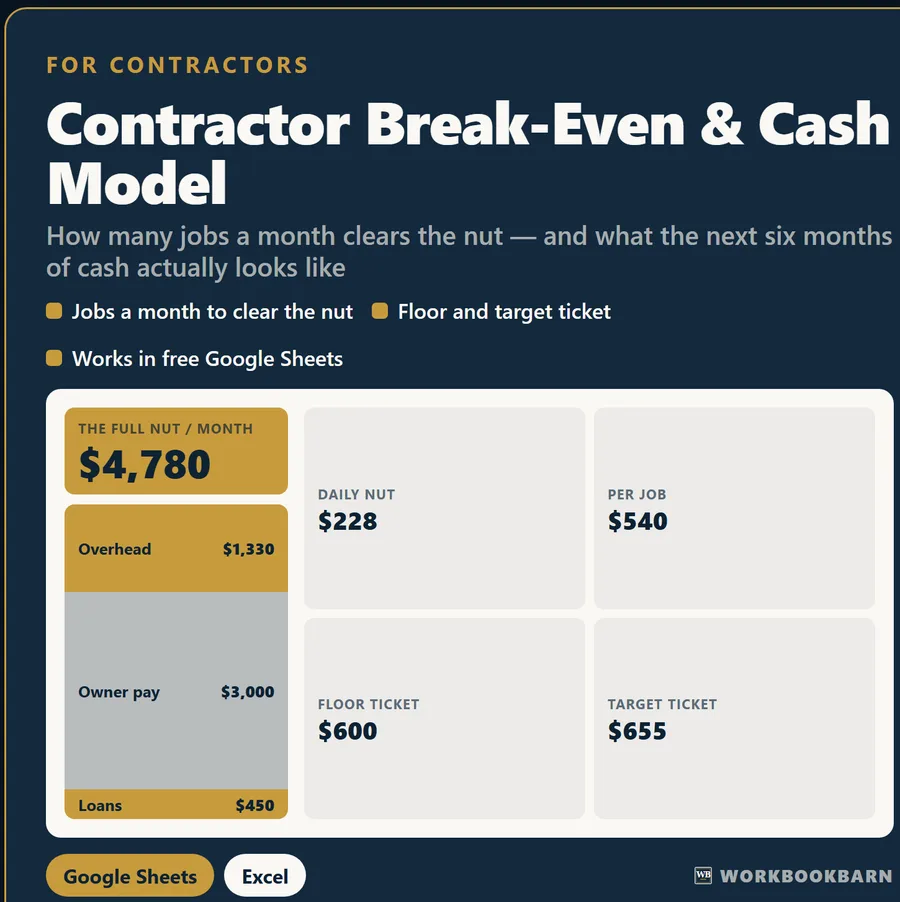
Contractor Break-Even & Cash Model
Run the numbers from this guide yourself — free, in the browser, no sign-up. Keep the full workbook if it earns its place.
Educational estimates only. These calculators and workbooks do the arithmetic on the figures you enter; they are general-purpose tools, not financial, investment, tax, legal, lending, insurance or construction advice, and no result is a quote, an offer, or a guarantee of any outcome. Results depend entirely on your inputs and assumptions. Verify anything you intend to rely on with a licensed professional — a CPA, attorney, lender, licensed contractor, or your own agent. WorkbookBarn and Marcos Gil accept no liability for decisions made using these tools. Marcos Gil is a licensed Kentucky real estate agent (License No. 296259) and is not a lender, CPA or attorney.