The Ledger · Trades
How to Start a Pressure Washing Business (2026 Cost & Rate Math)
Starting a pressure washing business costs $14,987 to $27,620 in sourced figures, and the break-even hourly rate on the kit's seeded numbers is $33.87.
Starting a pressure washing business costs $14,987 to $27,620 in sourced 2026 figures — an itemised equipment stack, a used work van, first-year general liability and launch marketing. The number that decides whether it survives is a different one: the break-even hourly rate, which on the model’s seeded figures is $33.87, and it takes 23.67 jobs a month at a $531 ticket to clear the nut.
Last updated: 2026-09-09
Good at the work, bad at the business. It is the most common sentence in every pressure washing forum, and it is normally followed by “what do I charge for a driveway” and a truck seat full of receipts. Search this question and you get ten-step lists: buy a machine, get insured, post before-and-afters. All true, all free everywhere, and none of it puts a number on the page. The top-ranking guides today say startup runs “$1,500” or “$5,000 to $10,000” and stop; not one of them runs the arithmetic that tells you what an hour has to bring in. So this guide does the boring half — the itemised cost stack, the break-even hourly rate formula, and the jobs-per-month count — from the same sourced dataset behind our startup-cost comparison for 40 trades and the same arithmetic that runs inside the free calculator.
How much does it cost to start a pressure washing business?
Between $14,987 and $27,620, computed as itemised equipment plus a used cargo van plus first-year general liability insurance plus a launch marketing budget.
That is a sum, not a guess at a national average, and the four components are added the same way for pressure washing as for the other 39 trades on the comparison page. The high column below is what the free companion kit seeds into its Startup Budget tab — deliberately the high end of every published range, so your own quotes typed over it can only move the total down.
| Component | Seeded figure (published high end) |
|---|---|
| Essential equipment, day one (11 items — see the next section) | $3,430 |
| Used cargo van (2018–2019 Ford Transit 250, roughly seven to eight years old) | $15,650 |
| General liability insurance, year one | $3,540 |
| Launch marketing | $5,000 |
| Total to start — Pressure Washing, high | $27,620 |
| Same four components, low end (comparison page) | $14,987 |
| Plus the kit’s 10% reserve line | $2,762 |
| Cash needed to start, high column with reserve | $30,382 |
Note what the machine is not. Equipment is $3,430 of a $27,620 stack; the van, the insurance and the money it takes to make a phone ring are $24,190 of it. That is the part the ten-step articles skip, and it is why so many operators “start” on a Saturday with a good machine and quietly stop by month four. The machine was never the barrier.
What equipment do you actually need on day one?
Eleven items, $2,103 to $3,430 depending where in each published range you buy: the machine, and ten things that make the machine earn money.
| Item | Seeded (high) | Published range |
|---|---|---|
| 4000 PSI / 3.5 GPM gas cold-water pressure washer, commercial grade | $1,199 | $899–$1,199 |
| 32–40 ft. fiberglass or aluminium extension ladder | $599 | $499–$599 |
| 65–100 gal. poly buffer tank with straps and base fittings | $469 | $300–$469 |
| Battery-powered 4-gal. backpack sprayer (soft-wash application) | $398 | $110–$398 |
| Hose and reel, 50–65 ft., rated to 4000 PSI | $244 | $106–$244 |
| Heavy-duty 20×30 ft. tarps (plant and landscaping protection) | $165 | $76–$165 |
| Extension wand / lance kit | $118 | $30–$118 |
| 12–16 in. surface cleaner attachment | $90 | $26–$90 |
| Safety glasses, gloves and PPE kit | $70 | $17–$70 |
| Downstream chemical injector kit | $62 | $30–$62 |
| Sodium hypochlorite house-wash concentrate, 1 gal. | $16 | $10–$16 |
| Total essential equipment | $3,430 | $2,103–$3,430 |
The buffer tank is the line beginners cut and then regret. It sits between the customer’s spigot and your pump, so a slow supply cannot starve the pump and cavitate it — a $469 part protecting a $1,199 machine on houses where the outside tap will not keep up with 3.5 gallons a minute. Cut the surface cleaner instead and you will simply be slow; cut the tank and you can lose the machine.
What hourly rate do you have to charge just to break even?
On the kit’s seeded figures, $33.87 an hour. That is the rate at which an hour pays your wage, your payroll burden and your share of fixed overhead, and returns exactly zero profit.
Here is the formula the Pricing tab actually runs, cell for cell — not a rule of thumb, the live expression:
billable hours per month = billable hours per week × 4.33

break-even hourly rate  = ( wage × (1 + burden%) × hours/month + overhead )
                          ÷ hours/month

rate at target margin   = break-even hourly rate ÷ (1 − target margin)

jobs per month to clear = ( wage × (1 + burden%) × hours/month + overhead )
                          ÷ ( average ticket × target margin )
And here is that formula run on the figures the kit ships with, so you can check every step against your own calculator:
| Step | Arithmetic | Result |
|---|---|---|
| Billable hours per month | 30 hrs/week × 4.33 | 129.9 |
| Wage plus burden, per hour | $21.17 × 1.25 | $26.46 |
| Labour cost for the month | $26.46 × 129.9 | $3,437.48 |
| Plus fixed overhead | $3,437.48 + $962 | $4,399.48 — the monthly nut |
| Break-even hourly rate | $4,399.48 ÷ 129.9 | $33.87 |
| Rate at a 35% target margin | $33.87 ÷ 0.65 | $52.10 |
| Jobs a month to clear the nut | $4,399.48 ÷ ($531 × 0.35) | 23.67 |
Run your own numbers in the free contractor break-even calculator — the same engine, in your browser, nothing to download. Change the overhead line first; it is the one most people guess at and the one that moves the answer most.
So what should you charge for a driveway?
$52.10 an hour at a 35% target margin on those seeds — break-even divided by one minus the margin. Per-square-foot pricing does not escape that floor, it just hides it.
Flatwork is normally quoted per square foot and house washes as a flat rate, and neither is wrong. But a square-foot price is only a way of arriving at a dollar figure for a job, and every job still takes hours. Take any quote you are about to give, divide it by the hours the job will genuinely consume — setup, water hookup, the wash, the rinse, teardown and the drive — and compare it to $33.87. Below that line you paid for the privilege of working. Between $33.87 and $52.10 you worked for less margin than you planned. That single division is the whole of pricing discipline, and it is why a minimum charge exists: a small job burns the same setup and drive as a large one.
Note also what the 30 billable hours a week in the model is not: it is not a 30-hour week. It is a full week minus quoting, driving, chasing chemical, invoicing and the customer who wants to walk you around the house first. Drop to 20 genuinely billable hours and the same $962 of overhead spreads over 86.7 hours instead of 129.9, and the floor climbs.
How many jobs a month do you need?
23.67 on the seeded figures — a $4,399.48 nut divided by the $185.85 of margin a $531 job throws off at a 35% margin.
Call it 24 jobs, and note that the kit’s own expectation line ships seeded at 12. That gap is the entire point of running the number before you start rather than after. Nothing is wrong with the spreadsheet; it is showing you that on those inputs the plan does not close, and that you have four levers and only four: raise the ticket, raise the margin, cut the overhead, or do more jobs. A guide that hands you an encouragement paragraph instead of that division is not helping you. Seeing the same arithmetic on a different cost stack is worth ten minutes — the handyman walkthrough runs the identical formulas on a trade with cheap equipment and an expensive van.
What do you do about the wash water?
Ask your municipality before the first commercial lot, because what may run into a storm drain is decided locally and the answer changes across a county line.
The framework is federal but the enforcement is not. The United States Environmental Protection Agency states that to prevent harmful pollutants from being washed or dumped into municipal separate storm sewer systems, certain operators are required to obtain NPDES permits and develop stormwater management programs (retrieved 2026-09-09). Your city runs its programme under that permit, which is why the rule you actually have to follow — containment, reclaim, where you may discharge — comes from the city or county, not from a national article. That is also why the Startup Budget seeds licences and permits at $0 rather than at a made-up national figure: a single number would be wrong nearly everywhere. Get yours from your own municipality and state licensing board before you quote work that crosses the threshold.
What do you set aside for self-employment tax?
Plan around the statutory self-employment tax rate of 15.3%, which the Internal Revenue Service states is 12.4% for Social Security plus 2.9% for Medicare (retrieved 2026-09-09).
None of the rates above include it. The break-even hourly rate covers wage, burden and overhead; self-employment and income tax come out of what is left. Federal and state income tax vary far too much by situation for anyone to put a single honest number on a page, which is why the workbook leaves them as lines you fill in with a CPA rather than a figure we invent for you. This is a planning tool, not tax advice.
What is actually in the plan?
The free pressure washing companion kit is the Excel financial model this whole guide was computed from: a Startup Budget tab seeded with the published high end of every range, a Pricing tab carrying the break-even formulas above with the arithmetic live, a twelve-month forecast with this trade’s seasonality, and every worksheet from the book as a printable PDF. It costs nothing and it does not need the book to work.
The Pressure Washing Business Startup Plan & Workbook is a 142-page PDF at $14.99 on Etsy — the 13-chapter plan you fill in, covering licensing, pricing, soft-wash offers and leads. There is no $997 course at the end of this page, no webinar, no upsell ladder. Every figure in the book cites a published source and every formula in the kit is machine-checked against the spreadsheet it came from, which is the check that produced the verified numbers in the tables above.
Common questions
Can I start with a homeowner machine and my own truck?
You can start, and the arithmetic changes in your favour: the van is $15,650 of a $27,620 stack, so a paid-for truck removes the single largest line. What it does not remove is first-year general liability at $3,540 and the $5,000 launch marketing line, which are $8,540 of cost before a phone rings. On the machine itself, the seeded 4000 PSI / 3.5 GPM commercial unit is $1,199 against a published range starting at $899 — the gap between that and a homeowner unit is duty cycle and repair parts, not pressure.
Is $33.87 an hour really the floor?
It is the floor for the seeded inputs and nothing else: $21.17 wage, 25% burden, 30 billable hours a week, $962 monthly overhead. Every one of those is a cell you type over, and the answer moves the moment you do. That is why the number is published with its formula and its inputs attached rather than as a national average — put your own overhead into the free calculator before you print a rate card.
Do I need a licence to pressure wash?
It depends on your state, your county, and often on the kind of surface and the size of the job, which is why the kit leaves licences and permits as a blank line rather than a national figure. Two separate questions decide it: business registration and any trade or contractor licensing threshold, and separately whether your municipality regulates where wash water may go. Get both answers from your own state licensing board and city before your first paid job.
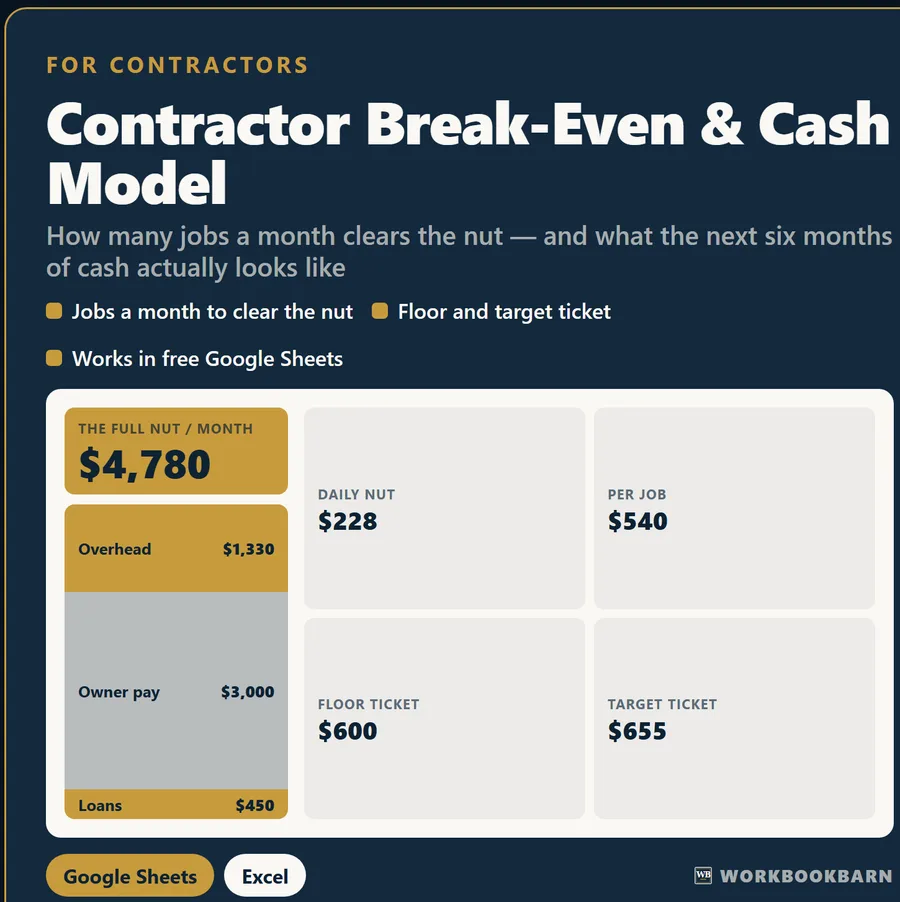
Contractor Break-Even & Cash Model
Run the numbers from this guide yourself — free, in the browser, no sign-up. Keep the full workbook if it earns its place.
Educational estimates only. These calculators and workbooks do the arithmetic on the figures you enter; they are general-purpose tools, not financial, investment, tax, legal, lending, insurance or construction advice, and no result is a quote, an offer, or a guarantee of any outcome. Results depend entirely on your inputs and assumptions. Verify anything you intend to rely on with a licensed professional — a CPA, attorney, lender, licensed contractor, or your own agent. WorkbookBarn and Marcos Gil accept no liability for decisions made using these tools. Marcos Gil is a licensed Kentucky real estate agent (License No. 296259) and is not a lender, CPA or attorney.