The Ledger · Trades
Sales Commission Structure: Paying on Margin Instead of Revenue
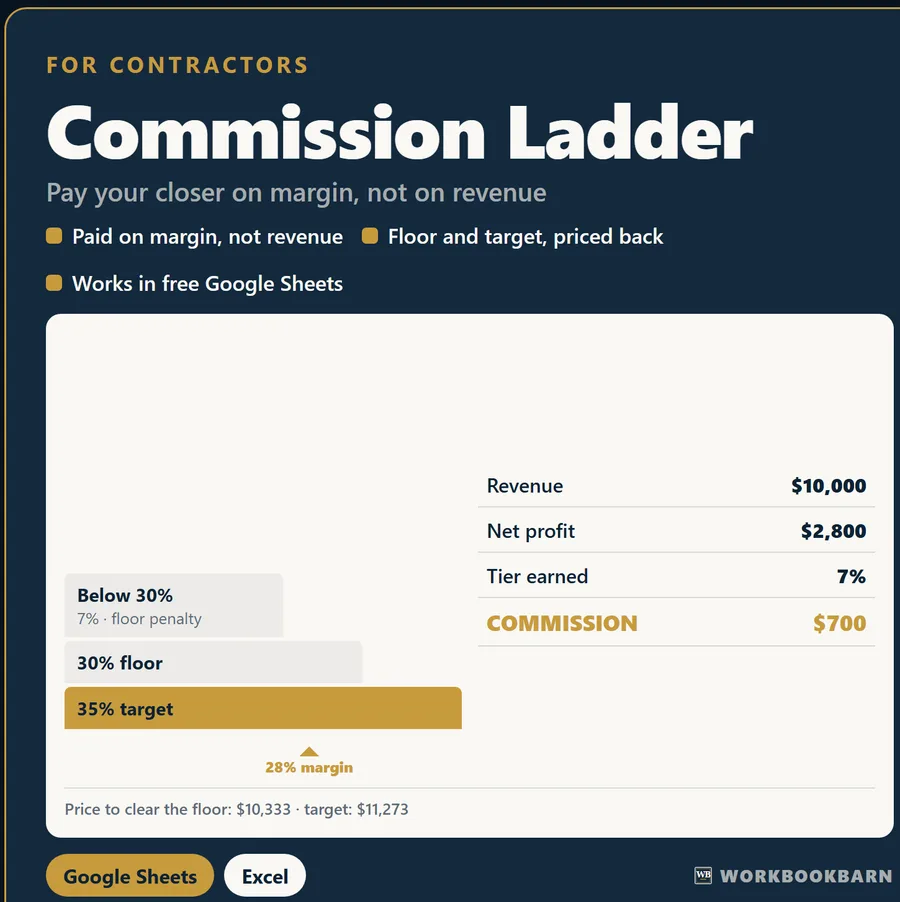
A margin-based sales commission structure lets the job's net margin pick the rate: on the Commission Ladder's seeded $10,000 job at 28.0% net margin that is $700, not the $1,500 a flat 15% of revenue would have paid.
A margin-based sales commission structure lets the job’s net margin pick the rate, so the closer is paid on what the job earned instead of on what the price promised. On the Commission Ladder’s seeded $10,000 job — $1,000 house fee off the top, $6,200 of hard costs, $2,800 of net profit, a 28.0% net margin — the ladder pays 7%, or $700. A flat 15% of revenue would have paid $1,500 out of that same $2,800.
Almost everybody pays commission on revenue, and for an understandable reason: revenue is the number printed on the contract. It is the easiest number to agree on, the easiest to check, and the only one the closer saw before he signed. The trouble is that revenue is also the one number in the deal that says nothing at all about whether the job made money. Pay a fixed percentage of it and you have written a plan that pays exactly the same on a job you win well and a job you give away, and that quietly pays the most on the jobs that hurt you most — because a thin price is usually a bigger price than a fair one.
Every dollar figure below is a verified seed value from the Commission Ladder workbook’s LADDER and JOB LOG sheets, with the cell it comes from. You can run your own job through the same formulas in the free commission ladder calculator.
What is a margin-based sales commission structure?
It is a plan where the job’s net margin picks the commission rate, so a thin job pays a thin rate and a healthy job pays a better one than a flat plan ever would.
Mechanically it has three moving parts and that is all. A house fee comes off the top before anything is measured — the seeded plan takes 10%, which is the overhead the job has to carry before it is allowed to call itself profitable. Then hard costs come off, and what is left is net profit and net margin. Finally a ladder maps that margin to a rate: below a floor the rate drops, above it the rate climbs.
The published guides to commission structures are good on the taxonomy — straight commission, tiered, draw against commission, gross margin, multiplier, territory volume — and most of them show a rate applied to a number. What almost none of them show is the three things that decide whether a margin plan survives contact with a real job: a floor with a penalty rate under it, a draw reconciled against a payout that can land near zero, and the price that would have cleared the floor. Those are the rest of this guide.
What does the same job pay on revenue versus on margin?
On the seeded $10,000 job the margin ladder pays $700 and a flat 15% of revenue pays $1,500. The company keeps $2,100 under the ladder and $1,300 under the flat plan.
| Line on the LADDER sheet | Cell | Value |
|---|---|---|
| gross revenue | F5 | $10,000 |
| house fee, 10% off the top | F8 | $1,000 |
| total hard costs | F11 | $6,200 |
| net profit | F14 | $2,800 |
| actual net margin | F15 | 28.0% |
| distance above the 30% floor | F16 | −2.0% |
| tier earned | F23 | 7.0% |
| gross commission | F24 | $700 |
| less booking draw | F25 | −$500 |
| final commission payout | F27 | $200 |
| commission as share of net profit | F32 | 25.0% |
| company keeps after commission | F33 | $2,100 |
| flat 15% of revenue would pay | F36 | $1,500 |
| company keeps under a flat plan | F37 | $1,300 |
| ladder keeps you ahead by | F38 | $800 |
Read the last three rows together, because they are the whole argument. The flat plan is not cheaper or more generous in the abstract; it is more generous on exactly this job, by $800, and that $800 comes out of a $2,800 profit pool. A plan that pays more when the job earns less is not a pay plan. It is a subsidy with a percentage sign on it.
How does a margin floor change the payout?
The floor is the margin below which the rate drops. The seeded plan floors at 30%; this job landed at 28.0%, two points under, so the rate fell from 15% to 7%.
Three points on the seeded ladder are visible in the workbook, and they are enough to see its shape. Below the 30% floor the rate is 7% (F23 on the worked job). Once a job clears the floor the rate is 15% — that is where the $1,500 in F30, “would have paid above floor,” comes from. And row 1 of the JOB LOG is a job carrying a $185 house fee (F5) and $1,045 of net profit (G5), which is a 56.5% net margin (H5): it earns the 20% tier (I5), pays $370 (J5) and leaves the company $675 (K5).
- Below the 30% floor → 7% of revenue
- Above the floor → 15% of revenue
- At the JOB LOG’s 56.5% margin → 20% of revenue
The workbook prints the consequence in plain language in F31: what pricing it thin cost, $800. That is $1,500 minus $700, and it is the sentence a closer actually understands. The floor is not a punishment bolted onto the plan. It is the plan telling the person who sets the price that the price is their business too.
What price would have cleared the floor?
$10,333.33. Divide hard costs by one minus the house-fee rate minus the target margin, and you get the price the job needed in order to earn the better rate.
net profit        =  revenue - house fee - hard costs
net margin        =  net profit / revenue
tier rate         =  the ladder band that net margin falls in
gross commission  =  tier rate x revenue
payout            =  gross commission - draw - back-charges

price for a target margin  =  hard costs / (1 - house fee % - target margin)
That last line is the one worth memorising, because it is the only formula here that changes a decision while there is still time. Run it on the seeded job: $6,200 divided by (1 − 0.10 − 0.30) is $6,200 / 0.60 = $10,333.33, which is F18. Run it again for the 35% target and $6,200 / 0.55 = $11,272.73, which is F19.
So this job was signed $333.33 under the floor price (F20) — three hundred and thirty-three dollars on a ten thousand dollar job, a rounding error in any negotiation. That rounding error cost the closer $800 of commission and the company $0 of margin protection it did not already have. Nobody argues about $333 when they can see the $800 next to it, which is the entire reason to put the floor price on the same screen as the payout.
What happens when the draw is bigger than the commission?
The payout shrinks toward zero and can go negative. Here a $500 booking draw against $700 of gross commission leaves a final payout of $200, and the sheet shows it instead of hiding it.
A draw is an advance, usually paid at signing so the closer is not waiting on a collection cycle to buy groceries. Reconciled against a thin job it does what advances do: it eats most of the payout. A negative number here is not a spreadsheet error, it is a floor penalty on a thin job doing exactly what it was designed to do. What happens next is a policy question rather than an arithmetic one — most plans carry the negative forward against the next job rather than clawing it back — and whichever one you pick, the thing that matters is that it is written down before the first thin job, not after.
How do you tell whether the plan is affordable?
Divide the commission by the job’s net profit instead of by its revenue. At $700 on $2,800 of profit the closer is taking 25.0% of the profit, which is F32 on the sheet.
This is the single most useful column to add to a settlement sheet and the one almost nobody has, because commission is universally quoted against revenue and affordability is only ever decided against profit. Twenty-five percent of the profit pool is a number an owner can reason about. “Seven percent” is not. And on the same job the flat plan’s $1,500 would have come out of $2,800 of profit — more than half of it — which is the kind of sentence that ends the debate faster than any percentage does.
Is commission taxed differently from a regular paycheck?
Not taxed differently, withheld differently. IRS Publication 15 lists commissions as supplemental wages, and gives employers an optional flat 22% federal withholding method for them.
Publication 15 (Circular E) defines supplemental wages as “wage payments to an employee that aren’t regular wages” and names commissions in that list alongside bonuses, severance and awards (read 2026-10-07). Where the employee has not been paid more than $1 million of supplemental wages, the publication allows either withholding a flat 22% or combining the supplemental and regular wages and withholding as though the total were one payment. Which of those your payroll runs is a question for whoever runs your payroll; it changes the net on the check, not the gross the ladder computed.
Common questions
Should the rate apply to revenue or to net profit?
The workbook pays a percentage of collected revenue with the percentage chosen by the job’s net margin, because that is what a settlement sheet reconciles and it is the easier of the two to explain. Paying a percentage of net profit also works, but the rates have to be roughly twice as high to land in the same place — the same 7% tier applied to this job’s net profit pays $196 (F39) instead of $700 — and the closer ends up carrying cost overruns he did not cause. The LADDER sheet prints both. Pick one and write it down.
Will the workbook run in free Google Sheets?
Yes. File > Import > Upload > choose the file > Replace spreadsheet. Every formula was written to run in Google Sheets as well as Excel — no XLOOKUP, no LAMBDA, no dynamic arrays, no add-ons and no subscription.
Are the seeded numbers real?
The house rules and the ladder structure come from a working contractor pay plan rather than a template: a 10% house fee off the top, a 30% margin floor, a 35% target, and a rate that drops to 7% below the floor. The $10,000 job on the LADDER tab is that plan’s own worked example — $7,200 of cost once the house fee is counted, a 28.0% net margin, and a commission that falls from $1,500 to $700. The twelve jobs in the log are illustrative, built so every band fires. Type over all of it.
Run your own job through the free commission ladder calculator, or keep the whole plan — the ladder, the floor, the draw column, the twelve-job log — in the Commission Ladder workbook. And since every one of these payouts starts with a price, the companion piece is the one on why a 40% markup is only a 28.6% margin — the floor in this guide is the gauge that guide is reading.
Commission Ladder
Run the numbers from this guide yourself — free, in the browser, no sign-up. Keep the full workbook if it earns its place.
Educational estimates only. These calculators and workbooks do the arithmetic on the figures you enter; they are general-purpose tools, not financial, investment, tax, legal, lending, insurance or construction advice, and no result is a quote, an offer, or a guarantee of any outcome. Results depend entirely on your inputs and assumptions. Verify anything you intend to rely on with a licensed professional — a CPA, attorney, lender, licensed contractor, or your own agent. WorkbookBarn and Marcos Gil accept no liability for decisions made using these tools. Marcos Gil is a licensed Kentucky real estate agent (License No. 296259) and is not a lender, CPA or attorney.