The Ledger · Trades
How to Start a Roofing Business: Licensing, Pricing Math and Break-Even
Kentucky does not license roofing as a trade — but the number that sinks new roofing companies is pricing by markup instead of margin, a $371 gap on one job.
Starting a roofing business is mostly four decisions: the entity and EIN, the licences your state and city actually require, the insurance the first real customer will ask to see, and the price you put on the driveway conversation. Kentucky does not license roofing as a trade — but that is the easy half. The half that sinks new roofing companies is pricing by markup instead of margin, which quietly hands back money on every single job.
You are already good at the work. You can read a deck, you know what a bad valley looks like, and you can run a tear-off. The problem is everything that happens off the roof: the entity, the certificate of insurance, the number you pull out of the air standing in a driveway, and the month the truck payment beats the deposits. This guide answers the business half, with the actual arithmetic written out.
Do you need a licence to start a roofing business?
It depends entirely on your state, and roofing is one of the trades most often left off the state list. Kentucky is one of those states.
The Kentucky Department of Housing, Buildings and Construction states that it “licenses/certifies plumbers, electricians, boiler contractors, sprinkler and/or fire alarm contractors and building inspectors” (retrieved 15 September 2026). Roofing is not on that list. That is a statement about one state agency’s scope, not a statement that roofing is unregulated: city and county occupational licences, building permits, contractor registration and sales-tax registration are separate questions, and they are answered locally, not by the state board. Call the building department in the county you intend to work in and ask two questions — does a roof replacement pull a permit here, and does this city require an occupational licence — before you quote anything.
The federal piece is smaller than people expect. An EIN is free and takes minutes. The Internal Revenue Service is blunt about this: “Beware of websites that charge for an EIN. You never have to pay a fee for an EIN” (retrieved 15 September 2026). If a service quotes you a price to obtain one, that price is for filling in a form you can fill in yourself.
What does it actually cost to start a roofing business?
I am not going to give you a national number, because I do not have one that is sourced, and a made-up range is worse than no range at all.
Every “$10,000 to $50,000 to start a roofing company” figure you will read today is someone else’s market, someone else’s insurance quote and someone else’s truck. Roofing startup cost is dominated by three line items that are quoted to you, in your county, on your loss history: general liability, workers’ compensation, and the vehicle. None of those three can be looked up in an article. The useful move is to build the list once and price your own version of it:
- Entity filing with your Secretary of State, plus the EIN (free)
- General liability — get three quotes; carriers price roofing very differently from other trades
- Workers’ compensation, if you will have anyone on a roof but you
- Commercial auto on the truck, and the trailer
- Dump trailer or disposal account, and tear-off tooling
- Fall protection — harnesses, lifelines, anchors
- Ladders and a pump jack or staging set
- Supplier account setup, and whether they will give you terms in month one (usually not)
- Estimating and invoicing, and the float to cover material before the first draw lands
The free startup checklist calculator holds that list and totals your own figures. The number it returns is worth something, because every input is yours.
How do you price a roofing job so it actually makes money?
You divide by margin. You do not add markup. The bid price is cost plus overhead, divided by one minus your target margin — and that is a different number from cost times markup.
This is the single formula that separates a roofing company that grows from one that is busy and broke. Here is the exact walk-through the Roofing Bid & Profit Workbook runs on its seeded example, cell by cell, straight from its QA ledger:
| Step | Cell | Figure |
|---|---|---|
| Material subtotal | E80 | $3,750 |
| Direct cost | E84 | $3,750 |
| Sales tax, 6% on material | E85 | $225 |
| Total cost | E86 | $3,975 |
| Overhead, 12% of cost | E87 | $477 |
| Cost + overhead | E88 | $4,452 |
| Bid price | E89 | $5,936 |
| Profit | E90 | $1,484 |
| Margin check | E91 | 25.0% |
The formula in cell E89 is the whole point:
BID PRICE = (cost + overhead) / (1 - target margin)

          = 4,452 / (1 - 0.25)
          = 4,452 / 0.75
          = 5,936

profit    = 5,936 - 4,452 = 1,484
margin    = 1,484 / 5,936 = 25.0%   <- matches the target
Note what the sheet does with tax and overhead before it ever reaches the margin step. Sales tax rides on material only ($225 on $3,750), and overhead is charged as a percentage of cost ($477 on $3,975) rather than being "absorbed" — which is the polite word for forgotten. By the time the margin divide happens, the number being divided is a real, loaded cost.
The same sheet then reads three tiers off that one calculation — $5,461.12 good, $5,936 better, $6,826.40 best — and the proposal sheet auto-fills Option A at $5,461.12 and Option C at $6,826.40, so the tiers cannot drift away from the estimate that produced them. That is the mechanical reason to run tiers off a sheet rather than off a notepad: three prices typed by hand are three chances to quote below cost.
What is the 25% rule in roofing?
There is no 25% "rule". There is a 25% target gross margin, and the thing that breaks it is applying 25% as a markup — which lands you at 20% margin, not 25%.
Run both on the same loaded cost of $4,452 and watch the gap open:
MARGIN (divide):   4,452 / (1 - 0.25) = 5,936   profit 1,484   margin 25.0%
MARKUP (multiply): 4,452 x 1.25       = 5,565   profit 1,113   margin 20.0%

difference on ONE roof: 5,936 - 5,565 = 371
$371 on one roof. It is the same intention — "I want twenty-five percent" — expressed two ways, and one of them is wrong by a fifth of the profit. Multiply that gap by a season's worth of jobs and it is the difference between hiring a second crew and wondering where the year went. This is also why the conversion runs the other way round when you hear a markup number quoted at a supplier counter: a 25% markup is a 20% margin, and a 40% markup is a 28.6% margin. The markup and landed cost calculator converts between the two if you want to check a number you have been given.
How many roofs a month do you need to cover your overhead?
Take your fixed monthly costs and divide by the gross profit one average job leaves behind. That quotient, rounded up, is the number of jobs a month you cannot go below.
Using the seeded job above as the "average job", each one contributes $1,484 of gross profit. If your fixed monthly nut — truck payment, insurance, phone, software, your own draw — is a number you can write down, the division is immediate. What makes this dangerous in practice is that most new roofing owners have never written the nut down, so the break-even job count is a feeling rather than a figure, and the feeling is always optimistic in February.
The free contractor break-even calculator runs that division on your own fixed costs and your own average job profit. It takes about four minutes and it is the single most sobering four minutes of a new contractor's first year.
How do you measure a roof and know what to order?
Measure the footprint, multiply by the pitch factor to get true surface area, divide by 100 for squares, then add waste and round up to whole squares before ordering.
Pitch factor is the bit people eyeball and get wrong. It is not a table you need to memorise — it is one square root:
pitch factor = sqrt( 1 + (rise / run)^2 )

6/12 pitch   = sqrt( 1 + (6/12)^2 ) = sqrt(1.25) = 1.118
The takeoff sheet carries that through on a single 40 ft x 24 ft plane at 6/12 (the cell displays the factor rounded to 1.12 and computes on 1.118):
- 40 x 24 x 1.118 = 1,073.31 sq ft of actual roof surface (cell F6)
- 1,073.31 / 100 = 10.73 squares measured (cells G6 and F47)
- Squares to order: 13 (cell F49) — waste and whole-square rounding
Ten point seven three measured, thirteen ordered. The gap between those two numbers is the one that shows up as an unplanned second delivery on a Friday afternoon, and it is why the measured figure and the order figure live in two different cells instead of one.
How do you get your first five customers?
The first five come from people who already know your work — not from advertising. Referrals, your supplier's counter, and other trades working the same houses are the three reliable channels in month one.
Roofing is unusual among the trades in that the people best positioned to refer you are not homeowners. They are the general contractors, remodellers, property managers, gutter and siding crews and real-estate agents who are standing in front of a bad roof several times a month and have nobody good to hand it to. Being the person who answers the phone, shows up when promised, and produces a written scope with a price on it puts you ahead of a surprising share of the field before you have spent a dollar on marketing.
Two things make that referral convertible. First, a certificate of insurance you can send within the hour, because the commercial and property-manager work is gated on it. Second, a written proposal with tiered options rather than one number, because a single price is a yes-or-no question and three prices is a which-one question.
Do you need insurance to start a roofing business in Kentucky?
Kentucky does not license roofers, but the statute requires every covered employer to carry workers' compensation — and a subcontractor's lapsed coverage lands on you.
Two sentences in Chapter 342 decide most of what a new roofing company has to buy and file. Kentucky Revised Statutes 342.340 requires every employer under the chapter to "insure and keep insured" its liability for compensation with an organization authorized to write workers' compensation in the state, or to furnish the commissioner satisfactory proof it can pay the compensation directly and post acceptable security (statute as amended effective July 15, 2014). Whether a particular arrangement makes you an "employer" under that chapter is settled by the chapter's own definitions and confirmed with the Kentucky Department of Workers' Claims — not by a roofing guide, and not by an opinion at the supply counter.
The second sentence is the one that costs money quietly. Kentucky Revised Statutes 342.610(2) makes a contractor who subcontracts all or any part of a contract — and that contractor's carrier — liable for the payment of compensation to the employees of the subcontractor "unless the subcontractor primarily liable for the payment of such compensation has secured the payment of compensation as provided for in this chapter." Read that as an operating instruction rather than a legal curiosity: your sub's certificate is not paperwork for a folder, it is the thing standing between his crew's injury and your policy. The same section's heading also records a builder's proof of coverage as required for issuance of a building permit, which is why the permit desk asks for it before it asks for anything else.
General liability is a separate purchase from workers' compensation, and it is the one the commercial side gates on. The limit is not a number to guess at — it comes out of the contract you are being asked to sign and out of what your own agent will write. What is in your control is how fast you can produce a current certificate when a property manager asks, because that is usually the whole test.
Tracking that is arithmetic, not judgement, and it is what the free subcontractor insurance and W-9 compliance tracker runs:
uncovered share    = subs with no current certificate / subs you use
money at risk      = paid to subcontractors last year x uncovered share
carried every year = extra premium at audit + missing W-9 penalties + your time chasing paper
The worked example below is the seeded scenario checked in the Subcontractor Insurance & W-9 Compliance Tracker's own test ledger — the RULES & EXPOSURE sheet, cell by cell. It is a demonstration bench, not market data:
| What the sheet reports | Value | Cell |
|---|---|---|
| Share of the bench with no current paper | 33.3% | F5 |
| Share fully covered right now | 66.7% | F6 |
| Money paid to uncovered subs | $140,000 | F7 |
| Extra premium charged at audit | $12,600 | F10 |
| Missing W-9 penalties | $620 | F11 |
| Your own time chasing certificates | $1,950 | F12 |
| Carried every year | $15,170 | F13 |
$12,600 + $620 + $1,950 = $15,170, carried every year before a single claim, on a bench that is two-thirds covered. The audit line is the one people do not see coming: money paid to a sub with no certificate is commonly rated at a policy audit as though it had been your own payroll, so the missing certificate is re-billed to you as premium. Every figure in the Subcontractor Insurance & W-9 Compliance Tracker workbook was rebuilt in code from the same seed inputs and compared cell by cell before release, and the rate inputs are yours to type — the sheet holds no assumed audit rate, penalty or premium of its own.
Common questions
Does Kentucky require a state roofing licence?
The Kentucky Department of Housing, Buildings and Construction publishes that it licenses or certifies plumbers, electricians, boiler contractors, sprinkler and fire alarm contractors, and building inspectors. Roofing is not among them. City and county occupational licences, permits and registration are separate and are confirmed with the local building department.
Is a 25% markup the same as a 25% margin?
No. On a loaded cost of $4,452 a 25% markup produces $5,565 and a 20.0% margin, while a 25% target margin produces $5,936. The difference is $371 on that one job.
If I have no employees, does the workers' compensation rule still touch me?
The duty in KRS 342.340 falls on an "employer" under Chapter 342, and whether a particular arrangement makes you one is decided under that chapter's definitions and confirmed with the Kentucky Department of Workers' Claims. What the text settles either way: under KRS 342.610(2) a contractor who subcontracts part of a job, and that contractor's carrier, is liable for compensation to the subcontractor's employees unless that subcontractor has secured the payment of compensation. Subbing work out does not move the exposure off your side of the table by itself.
Why order 13 squares when the roof measures 10.73?
Because shingles are bought in whole squares and every roof has waste — cuts at hips, valleys, rakes and starter course. The workbook keeps the measured figure (10.73) and the order figure (13) in separate cells so the estimate prices reality and the purchase order covers the truck.
Where the rest of this lives
The arithmetic above is the part that gets skipped, so it is the part this site publishes for free. The free roofing companion kit collects the calculators in one place, and the Roofing Business Startup Plan & Workbook is the 13-chapter version you fill in — $14.99 as an ebook, $17.99 in paperback. That is deliberately the price of a book rather than the price of a course: every figure in it is sourced or is yours, and every formula is machine-checked before it ships. The Roofing Bid & Profit Workbook ($24.99) is the estimating half — the takeoff, tiers and job-cost sheets the cells above come from, with 28 checks behind them.
Starting a different trade? The same break-even and pricing math drives how to start an HVAC business; only the licensing gate changes.
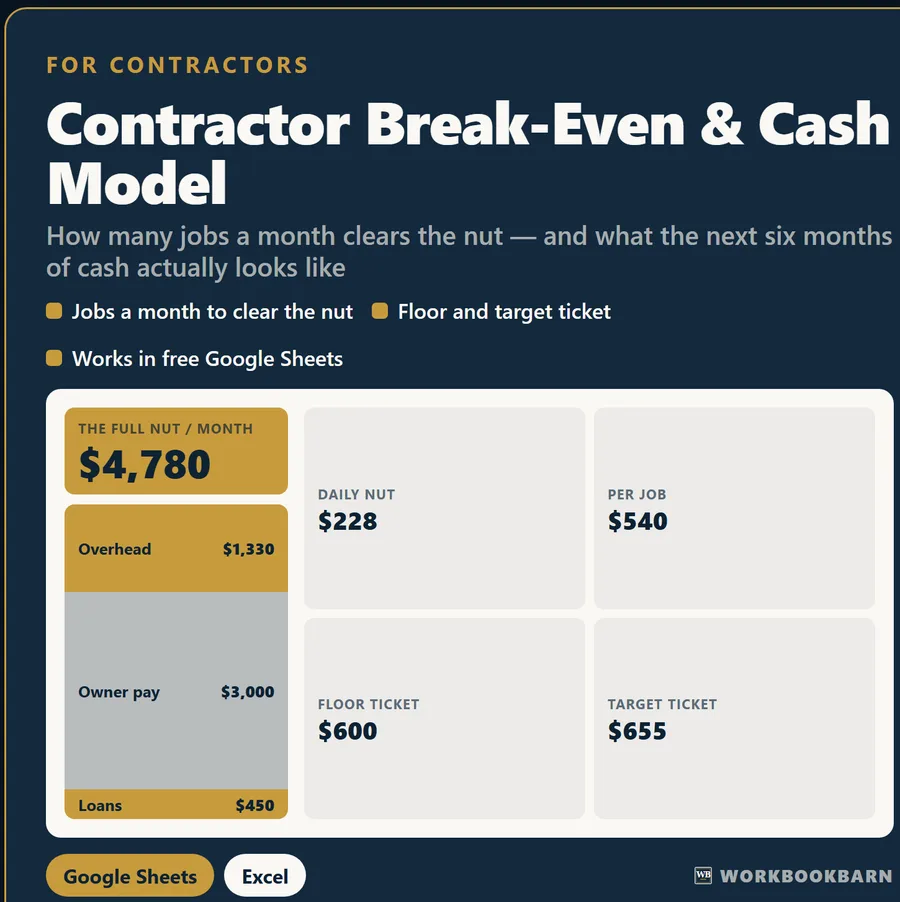
Contractor Break-Even & Cash Model
Run the numbers from this guide yourself — free, in the browser, no sign-up. Keep the full workbook if it earns its place.
Educational estimates only. These calculators and workbooks do the arithmetic on the figures you enter; they are general-purpose tools, not financial, investment, tax, legal, lending, insurance or construction advice, and no result is a quote, an offer, or a guarantee of any outcome. Results depend entirely on your inputs and assumptions. Verify anything you intend to rely on with a licensed professional — a CPA, attorney, lender, licensed contractor, or your own agent. WorkbookBarn and Marcos Gil accept no liability for decisions made using these tools. Marcos Gil is a licensed Kentucky real estate agent (License No. 296259) and is not a lender, CPA or attorney.